Dental Insurance Verification: A Complete Guide for Dental Practices

Dental Insurance Verification: A Complete Guide for Dental Practices
Dental insurance verification sounds simple.
Check whether the patient's insurance is active.
Find out what the plan covers.
Add the information to the patient's record.
But anyone who has worked at a dental front desk knows the reality is much more complicated.
A patient's plan can be active without covering the treatment they need. A procedure may be covered but subject to a deductible, frequency limitation, waiting period, annual maximum, or other plan provision. The information available through an online portal may not answer every question the practice has. After all of that work, verification still isn't a guarantee that the insurance company will pay a claim.
That's why dental insurance verification shouldn't be treated as a single administrative task. It's a chain of information that helps the practice and patient better understand the patient's benefits before treatment. When that chain works well, patients can arrive with clearer expectations and the front office can spend less time untangling insurance surprises after the fact.
This guide explains how dental insurance verification works, what dental offices should verify, common mistakes to avoid, and how practices can build a more consistent verification process.
What Is Dental Insurance Verification?
Dental insurance verification is the process of confirming a patient's insurance information and gathering relevant details about their eligibility and dental benefits. Depending on the patient, plan, payer, and planned treatment, a dental office may need to verify information such as:
Whether coverage is currently active
Effective dates
Subscriber information
Network status
Benefit period
Annual maximum
Remaining maximum
Deductible
Remaining deductible
Coverage percentages
Frequency limitations
Waiting periods
Age limitations
Procedure-specific provisions
Coordination of benefits
Orthodontic benefits
The purpose is not to determine with absolute certainty what an insurance company will ultimately pay. The purpose is to gather the best available information so the practice can understand the patient's benefits and communicate more clearly before treatment. That distinction matters.
Dental Eligibility vs. Benefits Verification
"Eligibility" and "benefits verification" are sometimes used interchangeably, but they answer different questions.
Eligibility asks:
Does this patient currently have active coverage under this plan?
Benefits verification asks:
What does this patient's plan indicate about coverage for the services we're evaluating? A patient can be eligible without having meaningful benefits available for a particular procedure.
For example, a patient's policy might be active, but:
Their deductible hasn't been met
Their annual maximum is nearly exhausted
The procedure is subject to a waiting period
They've already reached a frequency limit
The service isn't covered under the plan
Their plan pays differently for in-network and out-of-network providers
Simply seeing ACTIVE on an eligibility response doesn't answer those questions. That's why a strong dental insurance verification process goes beyond eligibility.
The Verification Chain
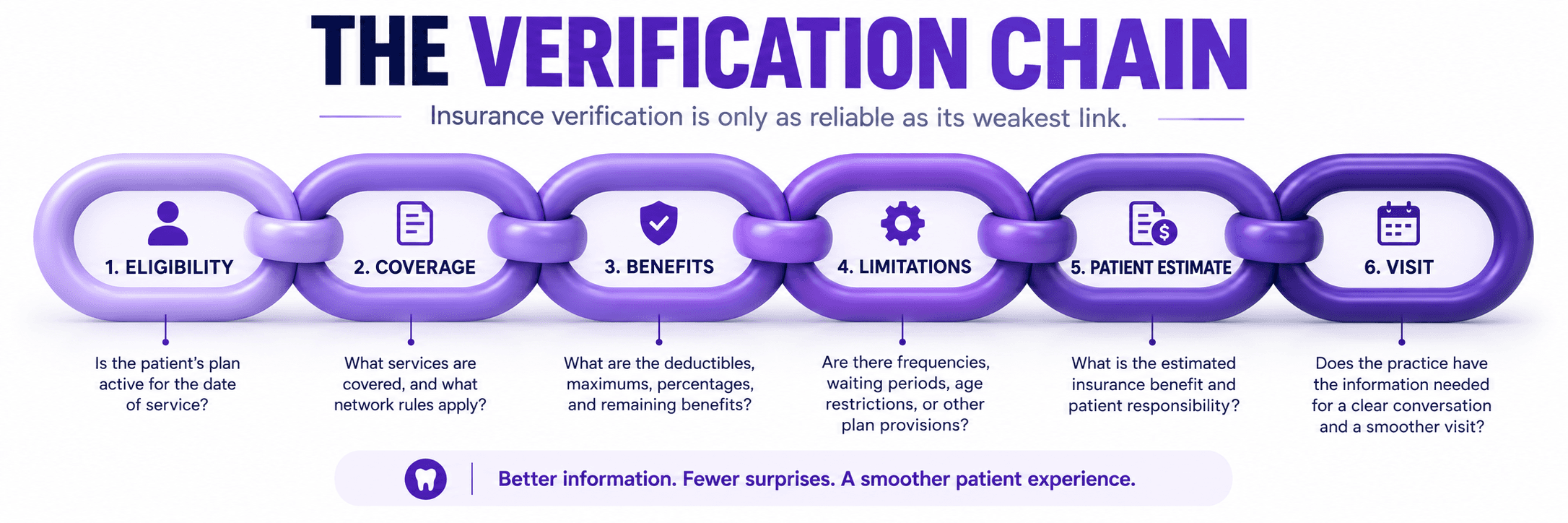
A useful way to think about insurance verification is as a sequence of connected questions:
Eligibility → Coverage → Benefits → Limitations → Patient Estimate → Visit
Each stage depends on the information before it.
1. Eligibility
Is the patient's plan active for the relevant date of service?
2. Coverage
What categories or services does the plan indicate are covered, and what network considerations apply?
3. Benefits
What does the plan report for deductibles, maximums, percentages, and remaining benefits?
4. Limitations
Are there frequencies, waiting periods, age restrictions, replacement rules, exclusions, or other provisions that could affect the benefit?
5. Patient Estimate
Based on the information available, what is the practice's estimate of insurance benefits and the patient's expected financial responsibility?
6. Visit
Does the practice have the information it needs to have a clearer financial conversation and move forward with treatment?
The important principle is simple: Insurance verification is only as reliable as its weakest link.
Confirming eligibility but ignoring limitations doesn't complete the process. Neither does finding a coverage percentage without checking the annual maximum. The pieces work together.
What Information Should a Dental Office Verify?
There isn't one universal verification checklist that applies identically to every patient and every procedure. But there are several categories practices commonly need to understand.
1. Patient and Subscriber Information
Start by making sure the practice has accurate information.
Common fields include:
Patient's legal name
Date of birth
Subscriber's name
Subscriber's date of birth
Relationship to subscriber
Member or subscriber ID
Group number
Employer, when relevant
Insurance carrier
Secondary coverage, when applicable
Small errors here can create larger problems later. An incorrect date of birth or subscriber ID can make valid coverage appear inactive or contribute to claim problems.
2. Eligibility and Effective Dates
Confirm whether coverage is active for the relevant date of service. Depending on the available information, practices may also want to identify:
Effective date
Termination date, if listed
Benefit period
Plan year vs. calendar year
This is particularly important when patients change employers or insurance plans. Never assume that insurance information from a previous visit is still current.
3. Network Status
Determine how the patient's plan treats the practice or provider.
Network status can affect:
Allowed fees
Reimbursement
Patient responsibility
Contractual adjustments
Practices should understand their own payer participation and avoid assuming that possessing a patient's insurance information means the office is in-network with that particular plan.
4. Annual Maximum
The annual maximum is the maximum amount a dental benefit plan may pay toward covered services during a defined benefit period, subject to the terms of the plan.
Two numbers are particularly useful: Annual maximum and remaining maximum.
A patient may have a $1,500 annual maximum but only $300 remaining. Those are very different financial situations.
5. Deductible
Determine:
The patient's deductible
Whether it applies to the planned service
How much has already been satisfied
How much remains
Don't assume every category of service applies to the deductible in the same way. Plan provisions vary.
6. Coverage by Service Category
Dental plans frequently organize benefits into categories such as:
Preventive
Diagnostic
Basic restorative
Major restorative
Endodontics
Periodontics
Oral surgery
Prosthodontics
Orthodontics
A plan may report different benefit percentages for different categories. However, a percentage alone should not be interpreted as a promise that the carrier will pay that percentage of the practice's fee.
Deductibles, allowed amounts, maximums, limitations, exclusions, network provisions, and other plan terms may affect the final benefit.
7. Frequency Limitations
This is one of the easiest details to overlook. A service may be covered generally but limited to a certain frequency.
Examples can include limitations involving:
Exams
Prophylaxis
Periodontal maintenance
Fluoride
X-rays
Crowns
Dentures
Other replacement procedures
The exact limitation depends on the plan. If frequency matters for the patient's planned treatment, verify it rather than relying on a general coverage category.
8. Waiting Periods
Some plans may require a patient to maintain coverage for a specified period before certain benefits become available. This can be particularly relevant when coverage is relatively new. When applicable, determine whether a waiting period exists and whether it has been satisfied.
9. Age Limitations
Certain benefits may be restricted based on age. Orthodontic benefits are a common example, but plan-specific age limitations may appear elsewhere. When age could affect coverage, verify the actual plan provision.
10. Replacement and Other Plan Limitations
Some plans place limitations on how frequently certain restorations or prostheses may be replaced. For example, benefits for a crown or denture may depend partly on when the previous restoration was placed. Other plan provisions may also affect coverage.
The important lesson isn't to memorize every possible limitation. It's to recognize that "covered" doesn't always mean "covered right now for this patient under these circumstances."
11. Orthodontic Benefits
If the practice provides or coordinates orthodontic treatment, verification may require additional information.
Depending on the plan, that can include:
Orthodontic coverage
Age limitations
Lifetime orthodontic maximum
Amount already used
Remaining lifetime maximum
Payment structure
Treatment-in-progress provisions
Orthodontic benefits can operate differently from standard annual dental benefits, so they deserve separate attention when relevant.
12. Coordination of Benefits
If a patient has more than one dental plan, determine whether coordination of benefits may apply.
The practice may need to identify:
Primary coverage
Secondary coverage
Subscriber relationships
Relevant plan rules
Secondary insurance doesn't necessarily mean the remaining patient balance will automatically be paid. Benefits still depend on the terms of the applicable plans.
Dental Insurance Verification Checklist
A standardized checklist can make the process much more consistent. For each patient, determine which of the following information is relevant to the upcoming visit.
Patient
Patient name and date of birth
Subscriber name and date of birth
Relationship to subscriber
Member/subscriber ID
Group number
Primary insurance
Secondary insurance, if applicable
Plan
Active coverage
Effective date
Benefit period
Network status
Annual maximum
Remaining maximum
Deductible
Remaining deductible
Benefits
Verify relevant benefit categories, which may include:
Diagnostic
Preventive
Basic restorative
Major restorative
Endodontics
Periodontics
Oral surgery
Prosthodontics
Orthodontics
Limitations
When relevant, check:
Frequency limitations
Waiting periods
Age limitations
Replacement limitations
Orthodontic lifetime maximum
Coordination of benefits
Other procedure-specific provisions
Documentation
Record:
Date verification was completed
Source of the information
Relevant reference or confirmation information when available
Important notes
Any information that still needs clarification
The checklist should be adapted to your practice, payer mix, procedures, and workflows. The goal isn't to collect every possible insurance field for every patient. It's to consistently collect the information necessary for the upcoming care.
When Should Dental Insurance Be Verified?
There is no single schedule that works for every dental practice. A useful principle is: Verify early enough to resolve problems before the patient arrives, but close enough to the appointment that the information remains useful.
Practices may establish different workflows for:
New patients
Existing patients
Patients reporting an insurance change
New benefit years
Major treatment
Patients with secondary coverage
Patients returning after a long absence
The exact timing depends on staff capacity, payer processes, and appointment type. The mistake is allowing verification to become an emergency task performed immediately before treatment.
Why Re-Verify Existing Patients?
Insurance changes.
Patients change jobs.
Employers change plans.
Benefit years reset.
Dependents gain or lose coverage.
Deductibles and annual maximums change as benefits are used.
A patient's insurance record should not be treated as permanently accurate simply because the information was correct at their last appointment. Practices need a repeatable way to identify when updated verification is appropriate.
How to Build a Better Dental Insurance Verification Process
Verification becomes especially frustrating when every team member handles it differently. A documented workflow can reduce that inconsistency. Here's a simple model.
Step 1: Identify Appointments Requiring Verification
Create a consistent way to identify which upcoming patients need insurance reviewed.
This could be based on:
New-patient status
Last verification date
Insurance changes
Benefit-year changes
Planned treatment
Missing information
Step 2: Confirm Patient Information
Before spending time researching benefits, make sure the practice has the correct subscriber and plan information.
Step 3: Verify Eligibility
Confirm that the coverage appears active for the relevant date of service. If it isn't, resolve that issue before going deeper.
Step 4: Gather Relevant Benefits
Collect the information necessary for the patient's planned visit or treatment. Avoid both extremes. Too little information creates uncertainty. Too much unnecessary information wastes staff time.
Step 5: Check Applicable Limitations
This is where many verification workflows become more useful.
Don't stop at: "Crowns: 50%."
Ask whether there are applicable limitations that could materially affect the benefit.
Step 6: Document Consistently
Decide exactly where verified information belongs.
Avoid spreading insurance notes across:
Sticky notes
Paper
Personal notebooks
Random PMS notes
Team messages
The next person who needs the information should be able to find it.
Step 7: Communicate Carefully With the Patient
Insurance information should help the patient understand their expected financial responsibility. But an estimate should remain an estimate. Final payment is determined according to the patient's plan and the carrier's processing of the claim. Clear language here can prevent an estimated benefit from being interpreted as a guarantee.
Insurance Verification Is Not a Guarantee of Payment
This deserves its own section because it's one of the most important concepts in the process. Verification helps a practice gather information about a patient's plan.
It does not guarantee:
Claim approval
Final reimbursement
The exact amount the carrier will pay
That all information provided will remain unchanged
That every plan provision has been identified
The ADA notes that predetermination or preauthorization of benefits does not guarantee payment, and the actual benefit may depend on eligibility and plan limitations when services are ultimately provided.
That is why practices should be careful with phrases such as: "Your insurance will pay $800."
A more appropriate financial conversation generally distinguishes between the treatment fee, the estimated insurance benefit, and the patient's estimated responsibility. That small wording change sets much clearer expectations.
Common Dental Insurance Verification Mistakes
Mistake #1: Only Checking Eligibility
Active coverage is the beginning of verification, not necessarily the end.
Mistake #2: Treating Coverage Percentages as Guaranteed Payments
A plan showing a percentage for a service category doesn't automatically tell you the final reimbursement.
Mistake #3: Ignoring Remaining Benefits
Annual maximum and deductible information is much more useful when paired with what has already been used or satisfied.
Mistake #4: Missing Frequency Limitations
A procedure can fall within a covered category but still be subject to a frequency restriction.
Mistake #5: Using Old Verification Information
Insurance information changes. Create a process for determining when it needs to be refreshed.
Mistake #6: Collecting Everything for Everyone
More data isn't always better.
Verification should be thorough enough for the patient's circumstances without turning every appointment into an exhaustive benefits investigation.
Mistake #7: Inconsistent Documentation
Information isn't very useful if only the person who verified it knows where to find it.
Mistake #8: Promising Insurance Payment
Always distinguish estimated benefits from guaranteed payment.
Manual vs. Automated Dental Insurance Verification
Traditionally, insurance verification has required front-office staff to:
Identify patients requiring verification
Find the payer
Log into a portal or use another available verification channel
Locate the patient
Review eligibility
Retrieve benefit information
Interpret relevant limitations
Enter the information into the practice workflow
Repeat the process for the next patient
None of those steps sounds especially dramatic. That's exactly why the workload can be underestimated. It's repetitive administrative work multiplied across patients, plans, providers, and days.
Automation changes the question from: "How can our team verify insurance faster?" to "Which parts of verification actually require our team's attention?"
What Can Dental Insurance Verification Automation Do?
Capabilities vary significantly by technology, payer access, and practice-management integration.
In general, automation may help with tasks such as:
Identifying upcoming patients
Checking eligibility
Retrieving available benefit information
Organizing insurance data
Updating workflows
Flagging missing or unusual information
Reducing repetitive manual entry
Human judgment still matters. Complex plans, ambiguous information, unusual treatment, payer discrepancies, and patient-specific questions may require staff involvement.
The strongest workflow isn't necessarily human or automation. It's Automate the predictable. Escalate the exceptions. That allows the front office to spend more of its time on situations that actually require a person.
How Annie Approaches Insurance Verification
Insurance verification is exactly the type of administrative work that can quietly consume a dental team's day. It has to happen. It matters to patients. But much of the workflow is repetitive.
Annie is built as a Digital Coworker for Dentistry, helping practices take recurring administrative work off the front desk rather than simply giving the team another software tool to manage.
Insurance verification is part of that broader idea. Instead of staff repeatedly working through predictable verification tasks patient by patient, Annie can help automate the workflow so the team can focus its attention on exceptions, patient conversations, and the work happening inside the practice.
The goal isn't to remove humans from important insurance conversations. It's to reduce the amount of repetitive work required before those conversations can happen.
How to Measure Your Insurance Verification Process
Once you establish a workflow, measure it. Potential dental insurance verification KPIs include:
Verification Completion Rate
What percentage of appointments requiring verification are completed before the practice's deadline?
Verification Exceptions
How many cases require manual intervention?
Time Spent on Verification
How much staff time is devoted to verification each week?
Same-Day Insurance Problems
How often does the team discover an insurance issue only after the patient arrives?
Verification Accuracy
How often does the team need to correct or substantially update information after initial verification?
Patient Financial Surprises
Are patients frequently encountering unexpected differences between estimated and actual benefits? You don't need a massive dashboard. You need enough information to determine whether the system is becoming more reliable.
A Simple Dental Insurance Verification Workflow
For practices building a process from scratch, start here:
Upcoming Appointment
↓
Does insurance need to be verified?
↓
Confirm patient and subscriber information
↓
Check eligibility
↓
Retrieve relevant benefits
↓
Review applicable limitations
↓
Document findings
↓
Estimate insurance benefit and patient responsibility
↓
Flag exceptions for staff review
↓
Patient arrives with the practice better prepared The process should become boring. That's a good thing. A strong administrative system doesn't depend on someone remembering what to do every time. It makes the next step obvious.
Frequently Asked Questions About Dental Insurance Verification
What is dental insurance verification?
Dental insurance verification is the process of confirming a patient's coverage and gathering relevant information about eligibility, benefits, deductibles, maximums, limitations, and other plan provisions before treatment.
What is the difference between dental eligibility and benefits verification?
Eligibility generally confirms whether a patient has active coverage. Benefits verification goes further by examining what the plan indicates about coverage, deductibles, maximums, percentages, limitations, and other details relevant to treatment.
How often should a dental office verify insurance?
There is no universal frequency appropriate for every patient. Practices should establish policies based on factors such as new-patient status, insurance changes, benefit-year changes, treatment needs, and how recently information was verified.
Does verifying dental insurance guarantee payment?
No. Verification does not guarantee that a claim will be approved or establish the exact amount an insurer will ultimately pay. Practices should communicate insurance amounts as estimates rather than guaranteed benefits.
What should be included in dental insurance verification?
Depending on the patient and treatment, verification may include eligibility, effective dates, network status, annual maximum, remaining maximum, deductible, remaining deductible, coverage categories, frequency limitations, waiting periods, age restrictions, replacement provisions, orthodontic benefits, and coordination of benefits.
Can dental insurance verification be automated?
Parts of the verification workflow can be automated, depending on payer access, technology, and practice-management integrations. Complex or ambiguous situations may still require human review.
What is a dental insurance verification checklist?
A dental insurance verification checklist is a standardized list of patient, plan, benefit, and limitation information a dental office uses to make the verification process more consistent.
Better Verification Creates Better Conversations
Dental insurance will probably never be the simplest part of running a dental practice. There are too many plans, provisions, limitations, patients, and variables for that. But the process surrounding it can be better.
A strong verification workflow helps a practice move from: "I think this is covered." to "Here's what we've been able to verify, here's the estimated benefit, and here's what you may be responsible for."
That's a much better conversation for the patient, the front desk, and for the practice. The goal of dental insurance verification isn't perfect certainty. It's better information earlier, so everyone can walk into the appointment with clearer expectations.
