Dental Practice Staffing: How to Build the Right Team for Your Dental Office

Dental Practice Staffing: How to Build the Right Team for Your Dental Office
When a dental practice gets busier, the solution can seem obvious: Hire another person.
The phones are ringing constantly.
Insurance verification is piling up.
Patients need to be confirmed.
Hygiene is booked out.
Someone needs to follow up on unscheduled treatment.
The front desk is trying to check in a patient while answering a phone call and explaining a bill to someone else.
Does the practice needs more staff? Maybe. But there's another question worth asking first: Does the practice need another employee, or does it need a better system?
Those aren't the same problem. Some capacity problems absolutely require people. A dentist can't automate an assistant who is needed chairside. A practice with more hygiene demand than its hygienists can serve has a clinical capacity problem. But other staffing problems are actually workflow problems.
If highly capable employees spend hours every week making repetitive confirmation calls, answering the same questions, tracking down routine information, or moving information between systems, hiring another person may simply add another employee to an inefficient process.
Modern dental practice staffing requires a different approach. The goal isn't to operate with the fewest people possible. It's to make sure your people are spending their time on work that actually needs people.
What Is Dental Practice Staffing?
Dental practice staffing is the process of determining which roles, skills, and capacity a practice needs to deliver patient care and operate effectively.
Depending on the practice, the team might include:
Dentists
Dental hygienists
Dental assistants
Office managers
Front desk or patient coordinators
Treatment coordinators
Insurance coordinators
Billing specialists
Scheduling coordinators
Larger practices may have dedicated employees for many of these functions. Smaller practices often combine them. One person might answer phones, schedule patients, verify insurance, collect payments, manage recalls, and check patients in and out. Neither model is automatically right or wrong. The better question is whether the practice has enough capacity in the right places.
Dental Staffing Is Really a Capacity Problem
Headcount is easy to measure, but capacity is more useful. Imagine two dental practices with the same number of employees. Practice A runs smoothly. Practice B constantly feels understaffed.
The difference could come from:
Patient volume
Procedure mix
Number of providers
Schedule design
Team experience
Technology
Workflow design
Role clarity
Call volume
Insurance workload
Automation
Practice-management systems
That's why simply asking "How many employees should a dental practice have?" usually isn't enough. A better question is "Where does our practice need more capacity?" That changes the staffing conversation completely.
The Dental Staffing Map
One way to think about staffing is to separate the work happening inside a dental practice into four categories.
1. Clinical Care
This includes work that directly requires clinical training and patient care.
Examples include:
Diagnosis
Treatment
Hygiene
Chairside assisting
Radiographs
Clinical documentation
Sterilization
Clinical patient education
These responsibilities depend heavily on licensed clinicians and trained clinical team members. If demand exceeds capacity here, the solution may genuinely require additional clinical staff, changes to scheduling, or both.
2. Patient Relationships
These are interactions where judgment, empathy, context, and human connection matter.
Examples include:
Complex patient questions
Treatment conversations
Financial conversations
Handling upset patients
Discussing patient concerns
Managing unusual situations
Treatment coordination
Building long-term relationships
Technology can support these interactions. It shouldn't eliminate the human judgment that makes them valuable.
3. Administrative Operations
These are the systems that keep the practice functioning.
Examples include:
Billing
Insurance management
Accounts receivable
Schedule oversight
Practice management
Payroll
Compliance
Reporting
Team coordination
Some of this work requires specialized knowledge, some can be delegated, and some can be outsourced. And parts can increasingly be automated.
4. Repetitive Workflows
This is where dental practices should look closely.
Examples might include:
Routine appointment confirmations
Recare outreach
Basic appointment scheduling
Repetitive phone questions
Cancellation follow-up
Routine reminders
Gathering basic patient information
After-hours call handling
These tasks are necessary. But necessity doesn't mean they require an employee to manually perform every step. That leads to the central question behind the Dental Staffing Map. Who, or what, is the best resource for each job? The answer will be different depending on the task.
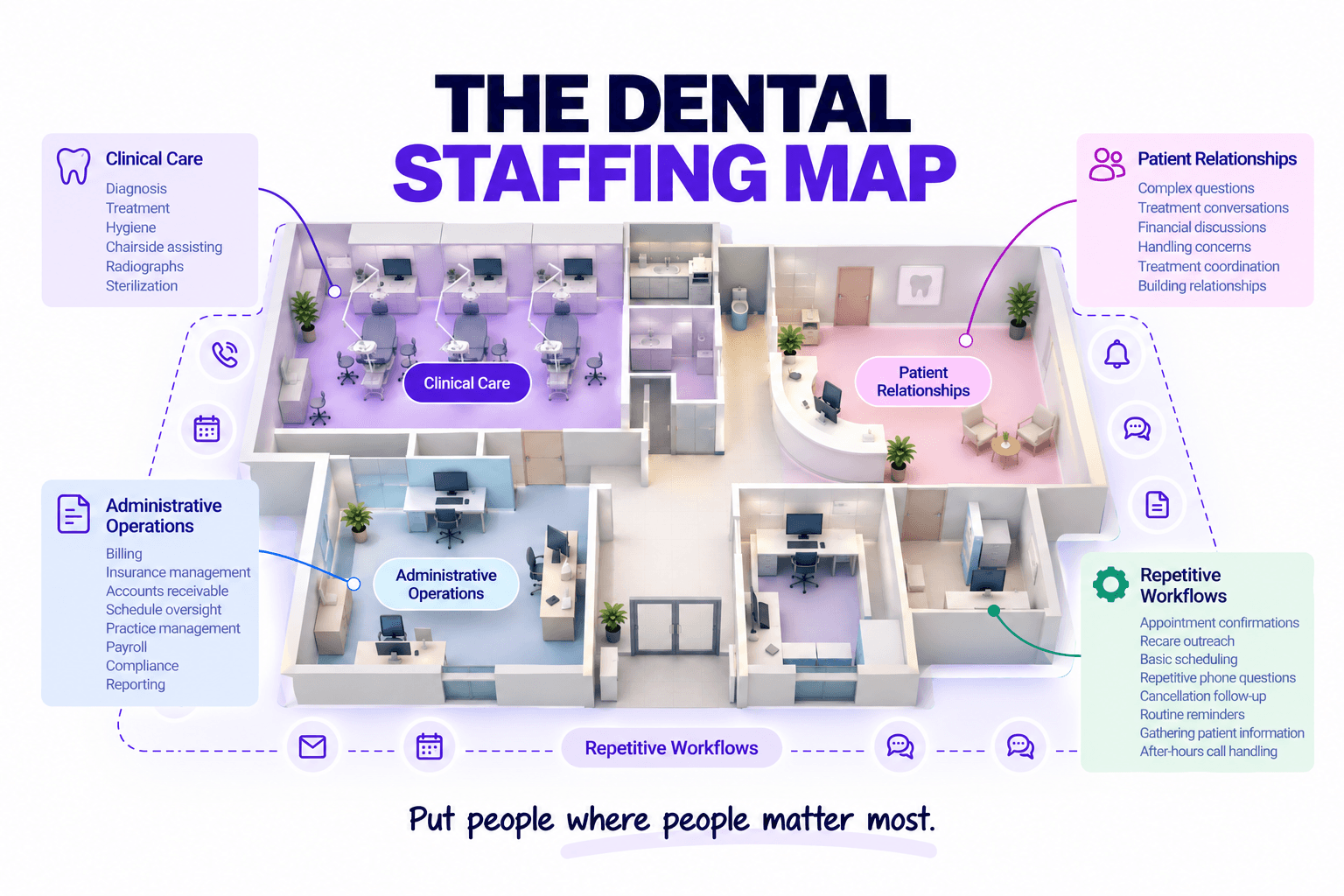
Put People Where People Matter Most
Consider the difference between these two interactions. A patient is upset because they received a large bill they weren't expecting. Another patient calls to ask "What time do you close?" Both are patient communications. They do not require the same resource.
The first may require context, empathy, account knowledge, judgment, and problem-solving. The second needs an accurate answer. When every interaction is routed through the same employees, valuable human capacity gets consumed by work that doesn't always require it.
Multiply that across hundreds of calls, messages, reminders, scheduling requests, and administrative tasks, and the staffing problem becomes clearer. Not all work has equal need for human attention.
What Roles Does a Dental Practice Need?
There isn't one universal staffing model for every dental office. But most practices need capacity across several core functions.
Dentists
Dentists diagnose conditions, develop treatment plans, perform procedures, and oversee clinical care. Doctor capacity is often one of the most important constraints in the practice. Adding administrative staff won't solve a clinical bottleneck caused by insufficient doctor availability.
Dental Hygienists
Hygienists provide preventive and periodontal care, patient education, assessments within their scope, and support long-term patient retention through the hygiene and recare program. Hygiene capacity can become a major constraint as the active patient base grows.
Dental Assistants
Dental assistants help doctors deliver care efficiently through chairside support, operatory preparation, sterilization, patient support, and other clinical responsibilities allowed within their jurisdiction and training. A doctor with insufficient assisting capacity may have available clinical time but still be unable to use it effectively.
Office Managers
The office manager typically helps coordinate the business and administrative side of the practice.
Responsibilities can include:
Team management
Practice systems
Scheduling oversight
Financial processes
Patient issues
Performance tracking
Hiring and training
Vendor coordination
The exact role varies considerably by practice size.
Front Desk or Patient Coordinators
Front-office team members may handle:
Phones
Scheduling
Check-in and checkout
Patient questions
Forms
Payments
Confirmations
Rescheduling
General patient communication
This is often where workload becomes especially fragmented. A front desk employee may switch between five different kinds of work within a few minutes.
Treatment Coordinators
Practices with more complex treatment may use treatment coordinators to help patients understand logistics, financial arrangements, scheduling, and the steps required to move forward with recommended care.
Insurance and Billing Team Members
Depending on practice size and complexity, insurance verification, claims, billing, collections, and accounts receivable may be handled by dedicated employees, shared administrative staff, or outside services. The key isn't having every possible job title. It's ensuring every critical function has an owner.
How Do You Know If Your Dental Practice Is Understaffed?
Being busy doesn't automatically mean being understaffed. Look for patterns. Potential signs of a genuine staffing or capacity problem include:
Providers regularly waiting for clinical support
Patients waiting excessively because the team cannot keep up
Important tasks repeatedly going unfinished
Team members consistently working beyond reasonable capacity
Hygiene demand significantly exceeding available hygiene capacity
Patient communication deteriorating
Billing or insurance backlogs growing
Schedule management becoming reactive
Employees unable to take time off without operations breaking down
Persistent bottlenecks despite efficient workflows
The last point matters. Understaffing should be diagnosed after looking at the system, not before.
Do You Need Another Employee—or a Better System?
Before creating another job posting, identify what is actually creating the workload. Take the complaint "The front desk is overwhelmed." That's a symptom. Now break it down.
Problem: The phone never stops ringing
Ask yourself these questions:
What percentage of calls require human judgment?
How many are routine scheduling requests?
How many are FAQs?
How many happen while employees are helping patients in person?
How many happen after hours?
The problem might be insufficient staffing, but it might also be a phone workflow problem.
Problem: Confirmations consume hours every week
You could hire someone to make more confirmation calls. Or, you could examine whether that workflow should require manual work in the first place.
Problem: The doctor is constantly waiting for an assistant
That's different. If clinical workflow is already efficient and assisting capacity is the constraint, technology isn't going to create another pair of hands chairside. The practice may genuinely need another clinical employee.
Problem: Insurance work is piling up
Determine what's causing it.
Is there simply too much volume for the current team?
Is information difficult to obtain?
Are employees duplicating work?
Is the process inconsistent?
Does the task require specialized expertise?
Could part of the workflow be automated or outsourced?
Problem: Nobody has time for recare
Again, ask why. Is the active patient base too large for the team? Or is recare dependent on someone manually finding patients, calling them one at a time, leaving voicemails, documenting the interaction, and remembering when to try again?
Those require different solutions. Don't hire against the symptom. Diagnose the workload.
Audit the Work Before You Hire
Before adding another employee, conduct a simple workload audit. For one or two weeks, identify where administrative time actually goes.
Group work into categories such as:
Clinical support
Patient relationships
Scheduling
Phones
Insurance
Billing
Recare
Confirmations
Cancellations
Data entry
Management
Other administrative work
You don't need employees tracking every minute of their day forever. You just need enough information to see patterns. Then ask four questions about each category:
Does this require clinical expertise?
If yes, it likely belongs with an appropriately trained clinical team member.
Does this require human judgment or empathy?
If yes, preserving human involvement may be valuable.
Does this require specialized administrative expertise?
If yes, consider whether that expertise should be hired, developed internally, or outsourced.
Is this predictable and repetitive?
If yes, investigate whether the workflow can be simplified or automated. Now you're making a staffing decision based on work instead of feelings.
Watch for Single Points of Failure
There's another staffing problem that has nothing to do with headcount:
Only one person knows how something works. Maybe one employee is the only person who understands:
Insurance verification
Claims
Payroll
The schedule
Practice reports
A particular software system
How the doctor likes certain appointments booked
Everything works perfectly until that employee takes a vacation, gets sick, or leaves. Then the system stops.
Cross-training doesn't mean everyone needs to know every job. It means critical workflows shouldn't exist exclusively inside one person's head.
Document:
Procedures
Responsibilities
Scheduling rules
Escalation paths
Important account information
Common exceptions
Standard workflows
A resilient practice can continue operating even when the normal owner of a task isn't available.
Create Clear Ownership
One common source of inefficiency is shared responsibility without clear ownership. If everyone is responsible for recare, who is actually responsible for recare? If anyone can handle cancellations, who makes sure the opening gets filled? If insurance verification is everyone's job, who checks that tomorrow's patients are complete?
Every important workflow should have a clear answer to: who owns this? That doesn't mean one person must perform every step. Ownership means someone or some system is accountable for the outcome.
Hire, Outsource, or Automate?
Modern dental practices have more options than simply: do it internally or hire another employee. For many operational needs, there are three broad choices.
Hire
Hiring makes sense when the practice needs ongoing human capacity that benefits from being embedded in the team. This is especially important for many clinical roles and responsibilities requiring frequent judgment, coordination, or relationship-building.
Outsource
Outsourcing can make sense when work requires expertise but doesn't necessarily need a full-time employee inside the practice. Examples can include certain billing, accounting, marketing, IT, or specialized administrative functions.
Automate
Automation makes the most sense when a workflow is:
Repetitive
Predictable
Rules-based
High-volume
Time-consuming
Frequently interrupted by competing priorities
The answer doesn't have to be only one. A practice might have an employee overseeing insurance operations, an outside billing partner handling particular tasks, and automation assisting with repetitive verification workflows. The objective isn't to choose a philosophy. It's to allocate resources intelligently.
The Best Automation Gives Time Back to People
There's a bad way to talk about automation in dental staffing: "How many employees can we replace?"
That's usually the least interesting question. A better one is: "What could our employees accomplish if repetitive work stopped consuming so much of their day?"
Imagine giving the front desk more time to:
Greet patients
Handle complex concerns
Discuss treatment logistics
Resolve financial questions
Support providers
Manage unusual situations
Build relationships
Or giving an office manager more time to:
Coach employees
Review performance
Improve systems
Solve operational problems
Plan growth
Automation creates the most value when it increases the capacity of good people.
Don't Automate Bad Processes
There is an important warning here. Automation doesn't automatically fix inefficient workflows. Sometimes it just makes the inefficiency happen faster.
Before automating a task, ask:
Does this task need to happen?
Is the workflow clearly defined?
Are the rules documented?
What happens when there's an exception?
Who owns the outcome?
Simplify first. Then automate.
How AI Changes Dental Practice Staffing
AI adds another type of capacity to the practice. Traditional software generally waits for a person to use it. Newer AI systems can increasingly participate in workflows themselves—communicating with patients, answering routine questions, scheduling within defined rules, conducting outreach, and handling other repetitive administrative processes.
That doesn't eliminate the need for a dental team. It changes the allocation of work. Consider a typical front desk.
Without automation:
Patient calls → employee stops current task → answers call → identifies need → handles request → documents outcome → returns to previous task
Now imagine that routine requests can be resolved without interrupting the employee. Human attention becomes available for the situations that actually need it. That's the staffing opportunity.
Where Annie Fits
Annie is designed as a digital coworker for dentistry. The idea isn't to remove people from the dental practice. It's to add administrative capacity without requiring every additional task to consume more employee time.
Annie can help with workflows such as:
Patient calls
Scheduling
Appointment confirmations
Cancellation management
Recare outreach
Insurance verification
Routine patient communication
Meanwhile, the practice's team remains focused on the work where people matter most.
Clinical care.
Complex conversations.
Patient relationships.
Judgment.
Problem-solving.
Leadership.
That's a different way to think about dental staffing.
Instead of asking "How many people do we need to complete all this work?" practices can increasingly ask "What is the best resource for each type of work?"
How to Build a Dental Staffing Plan
A staffing plan doesn't need to be complicated. Start with six steps.
Step 1: Map the Work
Identify the major functions required to operate the practice. Include clinical and administrative work.
Step 2: Identify Capacity Constraints
Where does work consistently pile up?
Where are patients waiting?
Where are providers waiting?
Where are opportunities being missed?
Step 3: Find the Root Cause
Don't stop at "We're too busy." Identify which work is consuming capacity and why.
Step 4: Categorize the Solution
Does the problem require:
Clinical capacity?
Human judgment?
Administrative expertise?
Better workflow?
Outsourcing?
Automation?
Step 5: Assign Ownership
Every important system should have a clear owner.
Step 6: Measure the Result
After making a staffing or workflow change, determine whether it actually solved the problem.
Look at measures such as:
Patient wait times
Call answer rates
Schedule utilization
Overtime
Administrative backlog
Recare activity
Insurance completion
Employee workload
Patient experience
Don't assume adding capacity solved the constraint. Measure it.
A Simple Dental Staffing Audit
Take your practice's major responsibilities and put them into a table.
Work | Who Handles It Today? | Human Judgment Needed? | Repetitive? | Capacity Problem? | Best Resource? |
|---|---|---|---|---|---|
Clinical treatment | Dentist | High | Low | ? | Person |
Hygiene | Hygienist | High | Moderate | ? | Person |
Chairside assisting | Dental assistant | High | Moderate | ? | Person |
Complex patient concerns | Front office/manager | High | Low | ? | Person |
Routine phone calls | Front office | Varies | High | ? | Person + automation |
Confirmations | Front office | Low | High | ? | Automation |
Recare outreach | Front office | Varies | High | ? | Person + automation |
Insurance | Admin team | Varies | High | ? | Person + outsourcing/automation |
Billing | Admin team | High | Moderate | ? | Person/outsourcing |
Schedule management | Front office | High | Moderate | ? | Person + automation |
The point isn't that every practice should fill out the last column identically. The exercise forces you to separate who currently does the work from who or what should do the work. That distinction is where better staffing decisions begin.
Frequently Asked Questions About Dental Practice Staffing
What is dental practice staffing?
Dental practice staffing is the process of determining the people, roles, skills, and capacity required to provide patient care and operate a dental office effectively. It includes both clinical and administrative functions.
How many employees should a dental practice have?
There isn't one staffing number appropriate for every dental practice. Staffing needs depend on factors including provider count, patient volume, procedure mix, office hours, operatories, hygiene demand, administrative workload, technology, and workflow design.
What staff does a dental office need?
Most dental practices require capacity across clinical care, chairside assisting, hygiene, patient communication, scheduling, billing, insurance, and practice management. The specific job titles and number of employees depend on practice size and structure.
How do you know if a dental office is understaffed?
Possible signs include persistent unfinished work, excessive patient or provider waiting, growing administrative backlogs, consistent overtime, poor patient communication, unavailable clinical capacity, and workflows that fail whenever one employee is absent. Practices should investigate the underlying cause before assuming headcount is the problem.
Should a dental practice hire or outsource?
Hiring can make sense when the practice needs ongoing embedded human capacity. Outsourcing can be useful for specialized functions that don't require a full-time internal employee. Many practices use a combination of internal employees and outside services.
Can dental offices automate front desk work?
Some front-office workflows can be partially or substantially automated, particularly repetitive and rules-based work such as routine communication, appointment reminders, confirmations, certain scheduling tasks, and outreach. Complex patient situations should still have a clear path to human support.
Can AI replace dental office staff?
A more useful way to think about AI is as additional administrative capacity. AI can handle certain repetitive workflows while employees focus on patient relationships, judgment, clinical support, management, and complex situations that benefit from human involvement.
How can dental practices improve staff productivity?
Start by identifying where employee time goes. Simplify inefficient workflows, clarify responsibilities, document processes, cross-train critical functions, automate appropriate repetitive tasks, and add staff when genuine human capacity is the constraint.
Don't Build Your Team Around Your Inefficiencies
Growing dental practices need more capacity.
Sometimes that means hiring another dentist.
Sometimes it means another hygienist.
Sometimes it means another assistant, treatment coordinator, insurance specialist, or front-office employee.
And sometimes the answer isn't another person at all.
That's why the best staffing question isn't "How many employees should we have?", it's: "What work needs to get done, and what is the best resource to do it?"
Map the work. Find the bottlenecks. Separate human work from repetitive work. Protect the tasks where relationships, expertise, empathy, and judgment matter.
Then build the team and systems around those realities. The goal isn't to build the smallest dental team possible. It's to put people where people matter most.
