Dental Recare: The Complete Guide to Building a Better Recare System

Dental Recare: The Complete Guide to Building a Better Recare System
Every dental practice has patients who mean to come back.
They liked the dentist.
They had a good experience.
They know preventive care matters.
They may even have every intention of scheduling their next appointment.
And then life happens.
Six months becomes eight. A reminder gets ignored. A voicemail goes unheard. The patient changes jobs, gets busy with school pickup, postpones an appointment, or simply forgets.
Eventually, an active patient becomes an overdue patient.That's why dental recare matters.
A strong dental recare system doesn't simply remind patients that they're due. It creates a reliable process for keeping patients connected to their care, making the next appointment easy, identifying patients who are slipping away, and bringing overdue patients back into the practice.
Done well, recare can support healthier patients, a more predictable hygiene schedule, stronger patient retention, and more sustainable practice growth.
And it starts with understanding one important principle: Recare is a system, not a reminder.
What Is Dental Recare?
Dental recare is the ongoing process a dental practice uses to help existing patients return for appropriate preventive and continuing care.
Depending on the patient's needs, a recare program may include routine examinations, professional cleanings, periodontal maintenance, X-rays when clinically appropriate, and other continuing-care services recommended by the dental team.
Operationally, dental recare also includes everything required to help that care actually happen:
Pre-appointing patients
Appointment reminders
Confirmations
Rescheduling
Following up with overdue patients
Reactivating inactive patients
Maintaining accurate patient records
Tracking recare performance
In other words, the clinical recommendation is only one part of recare.
The practice also needs a system that turns that recommendation into a completed future appointment.
Dental Recare vs. Dental Recall: What's the Difference?
You'll often hear the terms dental recare and dental recall used interchangeably. Both generally describe the process of bringing existing patients back for ongoing care.
"Recall" has traditionally been used to describe reminding a patient that they're due to return. "Recare" is often used more broadly to describe the continuing-care relationship and the systems surrounding it.
For practical purposes, a dental recall system and dental recare system frequently address many of the same challenges.
What matters more than the terminology is whether your practice has a reliable process for keeping patients engaged between visits and helping them return when appropriate.
Why Dental Recare Matters
Recare sits at the intersection of patient health and practice health. For patients, consistent continuing care helps the clinical team monitor oral health and provide treatment according to each patient's individual needs.
For the practice, a healthy recare system can contribute to:
More consistent hygiene schedules
Better patient retention
Fewer gaps in the schedule
Stronger long-term patient relationships
More opportunities to identify needed treatment
Less dependence on constantly acquiring new patients
More predictable practice activity
Think about the alternative. A practice spends money acquiring a new patient. The front desk schedules them. The clinical team provides excellent care. The patient leaves happy.
Then nobody successfully gets them back. The practice hasn't just lost a future hygiene appointment. It may have lost years of potential patient relationships. Acquisition gets patients through the door. Recare helps keep them there.
Why Patients Fall Out of Recare
It's tempting to assume overdue patients simply don't value dental care. Usually, the explanation is more complicated.
Patients fall out of recare for all kinds of reasons:
They forgot.
They cancelled and never rescheduled.
Their work schedule changed.
The office called while they were busy.
They intended to call back.
Scheduling felt inconvenient.
They moved.
Their insurance changed.
They became anxious about treatment.
The practice didn't follow up consistently.
Life simply became more urgent than dentistry.
Notice how many of these have nothing to do with whether the patient likes the practice. That's an important distinction. A patient can be perfectly satisfied and still become inactive. The goal of a dental recare system is to make staying engaged easier than drifting away.
The Recare Ladder
Most practices look at recare through two numbers:
Patients who are due and patients who returned. But a lot happens between those two points.
Think of recare as a ladder:
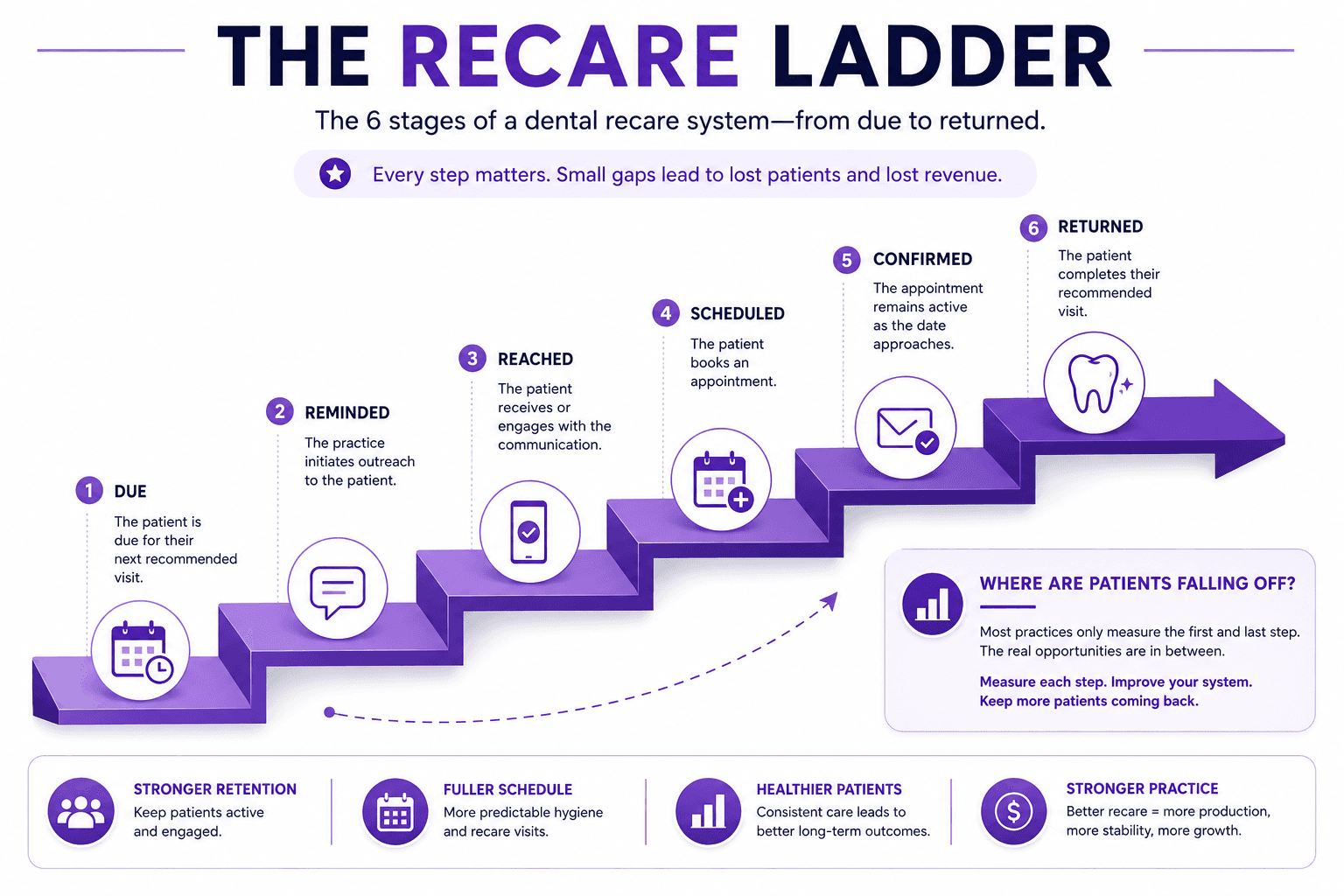
Step 1: Due
The patient has reached the appropriate point for their next recommended visit.
Step 2: Reminded
The practice has successfully initiated outreach.
Step 3: Reached
The patient actually receives or engages with the communication.
Step 4: Scheduled
The patient books the appropriate appointment.
Step 5: Confirmed
The appointment remains active as the date approaches.
Step 6: Returned
The patient completes the visit.
Every step matters. A practice could be excellent at sending reminders but poor at getting responses. Another might reach patients successfully but make scheduling too difficult. Another may schedule plenty of recare appointments but experience high cancellation or no-show rates before patients actually return.
Simply measuring "due" and "returned" hides those problems.
The Recare Ladder helps you ask a better question:
Where are patients falling off?
Once you know the answer, you know what to improve.
1. Build Recare Before the Patient Leaves
One of the strongest recare opportunities happens while the patient is still standing in your office.
Whenever clinically appropriate and operationally practical, help patients schedule their next recommended visit before they leave. Why? Because every additional step creates friction.
If a patient leaves without an appointment, they now have to remember they're due, decide when to schedule, find your phone number or scheduling option, contact the office, coordinate availability, and complete the booking.
That's a lot of opportunities for "I'll do it later." Pre-appointing removes much of that friction. Recare shouldn't begin six months after an appointment. It should begin at the current appointment.
2. Make Rescheduling Almost as Easy as Scheduling
Pre-appointing only works if patients can easily change an appointment when life changes. And life will change.
A patient who schedules months in advance may later encounter a meeting, vacation, school event, illness, or family obligation.
If rescheduling is difficult, they may cancel without immediately choosing another date. That is a dangerous moment in the recare process.
A strong system treats cancelled as needs a new appointment, not as the end of the workflow.
Make it easy for patients to reschedule and create a clear process for following up when a cancelled recare appointment isn't immediately rebooked.
3. Create a Defined Dental Recare Reminder Cadence
Random outreach creates random results. Your practice should have a clearly defined process for communicating with patients before an appointment and following up when they're overdue.
That doesn't mean every patient needs the exact same communication sequence. The right cadence depends on your patient population, technology, communication preferences, and clinical recommendations.
But your team should be able to answer questions like:
When does a patient receive the first reminder?
Which channels do we use?
What happens if they don't respond?
When does the communication change from reminder to overdue outreach?
When does a team member personally intervene?
How long do we continue appropriate reactivation efforts?
If nobody knows the answers, you don't really have a recare system. You have individual employees doing their best.
4. Use More Than One Communication Channel
One patient answers every phone call. Another never does. One responds immediately to text messages. Another prefers email.
Patient communication habits vary, so recare shouldn't depend entirely on one channel.
Depending on patient consent, preferences, applicable requirements, and your systems, a recare communication strategy may use a combination of:
Phone calls
Text messages
Email
Automated reminders
Personal outreach
The goal isn't to bombard patients. It's to communicate appropriately through channels they're likely to engage with.
5. Separate Reminders From Reactivation
A patient with an appointment tomorrow and a patient who hasn't visited in 18 months have different needs. They shouldn't receive the same message.
Appointment reminders help an already scheduled patient follow through. Reactivation outreach attempts to rebuild a connection with someone who has fallen out of care. That may require more context, more personalization, or a different conversation entirely.
For example, a reactivation conversation may need to acknowledge that it's been a while, make returning feel comfortable, answer questions, and remove whatever scheduling barrier has developed. Treating every overdue patient like another name on a reminder list misses that distinction.
6. Segment Your Overdue Patient List
A giant list of overdue patients isn't a strategy. Break the list into useful groups.
For example:
Recently overdue: Patients who are just beginning to slip beyond their recommended timing.
Cancelled but unscheduled: Patients who had an appointment but never selected a replacement.
Moderately overdue: Patients who haven't returned despite earlier outreach.
Long-term inactive: Patients who have been absent long enough that a more intentional reactivation approach may be appropriate.
You may also segment based on clinical or operational factors relevant to your practice. Segmentation makes outreach more relevant and gives the team a clearer place to start.
7. Remove Friction From the Scheduling Conversation
Imagine you finally reach an overdue patient.
They're ready to return.
Then scheduling becomes difficult.
They wait on hold.
They can't find a convenient appointment.
They need to call back later.
Or the office misses their return call.
You've successfully climbed several steps of the Recare Ladder only to lose the patient near the top. Every recare strategy should therefore include a scheduling strategy.
Ask:
How quickly can a patient reach us?
Can routine scheduling questions be answered immediately?
How easy is it to reschedule?
What happens after hours?
What happens when we miss a call?
Do patients have to repeat information?
How many interactions does it typically take to book?
The easier you make the next step, the more useful your outreach becomes.
8. Know When Automation Helps, and When a Human Should Step In
Automation can make dental recare significantly more consistent. It can help practices manage routine reminders, identify patients who need attention, support scheduling workflows, and maintain communication without asking employees to manually remember every next step.
But not every patient interaction should be automated. Some situations need empathy, judgment, or a personal conversation. A patient who hasn't returned because they're nervous about treatment may benefit from speaking with someone. A patient with a complex clinical situation may need a team member who understands their history. A patient simply trying to find an available hygiene appointment may not.
The goal shouldn't be automate recare, it should be automate the repetitive parts of recare so your team has more time for the human parts.
Where Annie Can Help
One of the biggest recare challenges isn't knowing what should happen. It's finding the time to make it happen consistently.
Your front desk is already answering phones, scheduling patients, checking people in and out, handling insurance questions, managing cancellations, supporting providers, and responding to whatever happens that day. Recare becomes another important task competing for attention.
Annie can help remove some of that communication burden by answering calls, assisting with scheduling, handling routine patient questions, and supporting patient communication without adding another interruption to the front desk.
That doesn't replace the relationships your team builds. It gives your team more room to focus on the patients and conversations that need them most.
How to Audit Your Dental Recare System
Use this quick audit with your team:
Question | What a Strong System Looks Like |
|---|---|
Are appropriate patients pre-appointed before leaving? | Consistently |
Can patients easily reschedule? | Yes |
Do cancelled appointments trigger follow-up? | Automatically or through a defined workflow |
Are overdue patients easy to identify? | Yes |
Is there a documented outreach cadence? | Yes |
Are patients segmented by recare status? | Yes |
Are multiple appropriate communication channels available? | Yes |
Does someone own recare performance? | Clearly |
Are recare metrics reviewed regularly? | Yes |
Does the team know when personal outreach is needed? | Yes |
If several answers are "sometimes," that's where to start. You don't need to rebuild everything at once. Fix the weakest rung of the ladder first.
Dental Recare Metrics Worth Tracking
You can't improve a system you can't see. Rather than tracking only the size of your overdue list, consider monitoring several points along the recare journey.
Pre-Appointment Rate
What percentage of eligible patients leave with their next appropriate visit scheduled?
Overdue Patient Count
How many patients have passed their recommended recare timing without a scheduled appointment?
Track the trend, not just the total.
Reactivation Rate
Of the inactive or overdue patients you contact, how many ultimately schedule and return?
Cancellation and Rescheduling Rate
How often do recare appointments cancel, and how many are successfully rebooked?
No-Show Rate
How many scheduled recare appointments fail to arrive?
Completed Recare Visits
Ultimately, how many patients actually complete their recommended continuing-care visits?
These metrics map naturally to the Recare Ladder. If patients are being reached but not scheduling, examine the offer and scheduling experience. If they're scheduling but not returning, examine confirmation, cancellations, and no-shows. If they're never being reached, examine your communication strategy and patient information.
Measurement turns recare from a vague front-desk responsibility into an operational system you can improve.
A Simple Dental Recare Workflow
A strong workflow doesn't have to be complicated.
At a high level:
1. Complete the current visit.
Determine the patient's appropriate next-care timing based on clinical needs.
2. Pre-appoint when appropriate.
Make the next step easy before the patient leaves.
3. Maintain accurate contact information and preferences.
Communication only works when it reaches the right person through an appropriate channel.
4. Confirm upcoming appointments.
Use a consistent process to help patients follow through.
5. Immediately address cancellations.
Whenever possible, replace the cancelled appointment instead of letting the patient become unscheduled.
6. Identify overdue patients.
Don't wait until they've been gone for years.
7. Follow a defined outreach process.
Use appropriate automation and human communication.
8. Escalate when necessary.
Some patients need a real conversation.
9. Make returning easy.
Remove unnecessary scheduling friction.
10. Measure what happened.
Find the weakest step and improve it.
Then repeat.
Common Dental Recare Mistakes
Even good practices can unintentionally weaken their recare system.
Watch for these patterns:
Waiting until patients are significantly overdue before reaching out
Relying entirely on patients to remember
Treating a cancellation as a completed task
Sending the same message to every overdue patient
Depending on one communication channel
Making patients call during limited office hours to schedule
Creating huge recare lists with no prioritization
Measuring outreach activity instead of completed returns
Expecting the front desk to manage recare without enough time or tools
Automating conversations that genuinely need a human
Most of these problems don't require a dramatic overhaul. They require a clearer system.
Frequently Asked Questions About Dental Recare
What is dental recare?
Dental recare is the ongoing process of helping existing patients return for appropriate preventive and continuing dental care. A recare system typically includes pre-appointing, reminders, confirmations, overdue-patient outreach, scheduling, and reactivation.
Is dental recare the same as dental recall?
The terms are often used interchangeably. "Recall" commonly refers to reminding patients to return, while "recare" can describe the broader continuing-care relationship and operational system surrounding future visits.
How often should dental patients be contacted for recare?
There isn't one communication cadence that's appropriate for every patient or practice. Outreach should reflect the patient's clinical needs, appointment status, communication preferences, applicable requirements, and your practice's established workflow. The important part operationally is having a consistent, documented process rather than relying on ad hoc outreach.
How do you reactivate overdue dental patients?
Start by identifying and segmenting overdue patients, using accurate contact information, reaching out through appropriate channels, making the message relevant to their situation, and making scheduling easy. Patients who need reassurance or have more complex circumstances may benefit from personal outreach from the team.
What should a dental practice track for recare?
Useful metrics include pre-appointment rate, overdue patient count, reactivation rate, cancellation and rescheduling rates, no-show rate, and completed recare visits. Tracking multiple stages helps identify where patients are falling out of the process.
Can dental recare be automated?
Parts of it can. Automation is useful for repetitive communication and workflow tasks, but practices should preserve human involvement for situations that require clinical context, judgment, reassurance, or more personal attention.
Better Recare Starts With a Better System
Patients don't usually wake up one morning and decide to abandon their dentist.
They drift.
An appointment gets cancelled.
A reminder gets missed.
A phone call happens at the wrong time.
Six months becomes nine.
Nine becomes twelve.
A strong dental recare system catches patients before that drift becomes disconnection.
It starts during today's appointment, makes tomorrow's appointment easy, maintains communication between visits, identifies patients who need attention, and gives the team a clear process for bringing people back.
The goal isn't simply a fuller hygiene schedule. It's continuity. Because the best recare system doesn't just remind patients that it's time to come back. It makes coming back the easiest next step.
