Dental Scheduling: How to Build a More Productive Dental Schedule

Dental Scheduling: How to Build a More Productive Dental Schedule
A completely full dental schedule can look like success.
Every chair is booked
Every provider has patients
There are barely any openings on the calendar
Then the day actually starts.
A crown runs long
The hygienist needs the doctor for an exam at exactly the wrong moment
An emergency patient calls
A new patient needs more time than expected
Someone cancels their two-hour appointment tomorrow morning
By lunch, the team is 30 minutes behind and the schedule that looked perfect on paper is creating stress for everyone. The problem isn't necessarily that the practice needs fewer patients. It may need a better-designed schedule.
Dental scheduling isn't simply the process of finding an empty space and putting a patient into it. A good schedule balances patient needs, provider capacity, production goals, appointment length, clinical complexity, staffing, emergencies, and the reality that not every day goes according to plan.
The goal isn't to fill every opening. The goal is to build a schedule that works. Here's how.
What Is Dental Scheduling?
Dental scheduling is the process of organizing patient appointments across providers, operatories, appointment types, and available time. But effective dental scheduling goes beyond maintaining a calendar.
A strong scheduling system helps answer questions like:
Which procedures should be scheduled at which times?
How much time does each appointment actually require?
Which providers can perform which procedures?
How should hygiene and doctor schedules interact?
Where should new patients go?
How much room should be available for emergencies?
What happens when someone cancels?
Which appointments should be protected from being filled with lower-priority procedures?
How much flexibility should exist in the day?
That's why scheduling has such an outsized effect on a dental practice. It sits at the intersection of patient experience, clinical care, team efficiency, and practice economics.
A Full Dental Schedule Isn't Necessarily a Good Schedule
One of the easiest scheduling mistakes is treating utilization as the only objective. If an opening exists, fill it. That sounds efficient. But imagine a schedule where every available minute is booked.
There is no room for:
A procedure running longer than expected
An emergency patient
A patient arriving late
A doctor exam during hygiene
An unexpected treatment opportunity
Sterilization or room turnover delays
A provider needing additional clinical time
The result can be a schedule operating at maximum theoretical capacity but poor practical capacity. The American Dental Association recommends balancing quality and quantity when managing office hours and warns that overscheduling can create pressure to rush appointments.
A productive schedule needs structure and flexibility. That's the difference between filling a calendar and designing one.
The Schedule Blueprint
Think of your dental schedule like an architectural blueprint. A building isn't designed by filling every square foot with something. Some spaces carry more weight. Some need to connect. Some need clearance. Some need flexibility.
A dental schedule works the same way. A useful Schedule Blueprint has five principles:
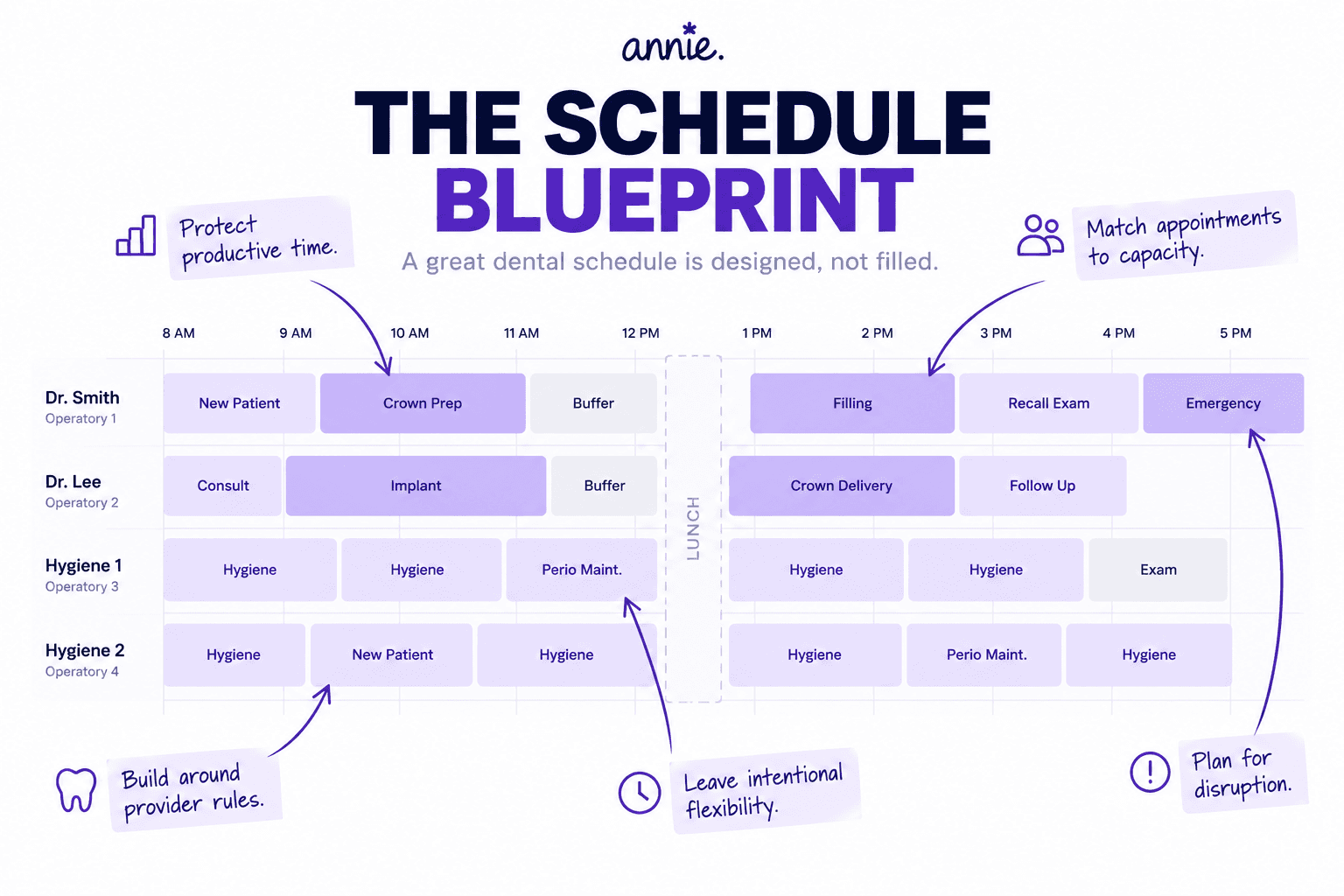
1. Protect Productive Time
Reserve appropriate blocks for procedures that require significant clinical time or contribute meaningfully toward production goals.
2. Match Appointments to Capacity
Schedule based on the actual time, provider, operatory, and team resources required.
3. Build Around Provider Rules
Define which providers perform which procedures, where, and under what circumstances.
4. Leave Intentional Flexibility
Not every minute should necessarily be treated as interchangeable capacity.
5. Plan for Disruption
Cancellations, emergencies, late patients, and procedures running long aren't unusual events. They're normal parts of operating a dental practice. A great dental schedule is designed, not filled.
1. Start With Capacity
Before deciding where appointments should go, understand what your practice can actually handle. Capacity includes more than office hours.
Consider:
Number of doctors
Number of hygienists
Available operatories
Assistants
Procedure requirements
Provider availability
Equipment
Sterilization capacity
Doctor checks during hygiene
Typical appointment duration
Two practices open from 8:00 a.m. to 5:00 p.m. can have completely different capacity. Even two Tuesdays inside the same practice can have different capacity depending on staffing and provider availability. Your scheduling rules should reflect reality rather than assuming every open slot is equivalent.
2. Define Your Appointment Types
One of the foundations of better dental scheduling is a clear appointment taxonomy. Instead of treating every appointment as simply "open time," define the types of appointments your practice routinely schedules.
Depending on the practice, these might include:
New-patient exam
Emergency exam
Periodic exam
Hygiene
Periodontal maintenance
Crown preparation
Crown delivery
Filling
Root canal
Extraction
Implant procedure
Denture appointment
Consultation
Limited exam
Each appointment type can have its own rules.
For example:
Duration: How much time should normally be reserved?
Provider: Who can perform the appointment?
Operatory: Where can it be scheduled?
Time of day: Are certain periods preferred?
Resources: Does the appointment require a specific assistant or equipment?
Patient status: Are the rules different for new and returning patients?
Once these rules are explicit, scheduling becomes much more consistent.
3. Use Realistic Appointment Durations
Scheduling problems often begin with unrealistic time assumptions. If an appointment routinely requires 70 minutes but the schedule gives it 60, the practice hasn't gained 10 minutes of productivity. It has simply borrowed 10 minutes from everything that comes afterward. Look at actual appointment performance.
Ask:
Which procedures regularly run over?
Which consistently finish early?
Does duration vary significantly by provider?
Are new patients getting enough time?
Are turnover requirements reflected in the schedule?
Are doctor checks creating predictable delays?
Appointment durations don't have to be identical across every provider. They should reflect how the practice actually operates.
4. Consider Block Scheduling
Block scheduling means intentionally reserving parts of the schedule for particular types of appointments rather than making every opening available for everything. For example, a practice might protect certain morning periods for longer restorative procedures while reserving other blocks for shorter appointments.
The objective isn't to make the schedule rigid. It's to prevent the easiest appointments to schedule from consuming the time needed for procedures that are harder to place.
Think of it like allocating inventory. If a two-hour clinical block is filled weeks in advance with appointments that could have fit almost anywhere, the practice may later struggle to accommodate a patient who actually requires two uninterrupted hours.
Build blocks around your practice
There is no universal dental block schedule. Your ideal structure depends on:
Procedure mix
Provider preferences
Production goals
Patient demand
Specialty
Staffing
Office hours
The important thing is that blocks have a reason for existing. Don't block time because another practice does it. Design the schedule around how your practice delivers care.
5. Schedule Productive Procedures Intentionally
Production shouldn't be the only scheduling objective. But ignoring production doesn't make sense either. Some practices establish daily production goals and then structure parts of the schedule to create a realistic path toward them.
That might mean protecting adequate uninterrupted time for procedures that contribute meaningfully to the day's production rather than hoping those appointments happen to fit around everything else. A schedule should support the practice's clinical and financial goals simultaneously.
The question isn't:
"How many patients can we see?"
It's:
"What combination of appointments creates a productive day without compromising care or overwhelming the team?"
6. Design the Hygiene Schedule Alongside the Doctor Schedule
Hygiene shouldn't operate like a completely separate business that happens to share the same building. Doctor and hygiene schedules interact throughout the day. Periodic exams are one obvious example.
If multiple hygiene appointments all require doctor checks around the same time the doctor is performing a procedure that shouldn't be interrupted, you've created a predictable bottleneck.
Consider:
When doctor exams typically occur
How many hygienists are working simultaneously
Appointment duration
Periodontal maintenance
New-patient hygiene needs
Provider handoffs
Operatory availability
Recare demand
The best time to solve these conflicts is when designing the schedule, not when three hygienists simultaneously need the doctor.
7. Create a Strategy for New Patients
New patients deserve intentional scheduling rules. They may require:
More intake time
Comprehensive examination
Imaging
Insurance review
Treatment discussion
Additional questions
More front-office interaction
At the same time, a new patient represents an important opportunity to establish a long-term relationship with the practice. Don't squeeze new patients into whichever opening happens to be available.
Determine:
Appropriate appointment length
Which providers see them
Which appointment types are appropriate
Whether same-day hygiene is offered
What information should be collected beforehand
How quickly the practice wants to accommodate new patients
The scheduling experience is one of the patient's first impressions of the practice. Make it intentional.
8. Reserve a Plan for Dental Emergencies
Emergencies are inherently unpredictable. The fact that they happen isn't. A practice that regularly treats emergencies should decide before the phone rings how those patients will be accommodated.
Possible approaches include:
Dedicated emergency blocks
Flexible periods during the day
Provider-specific emergency rules
Same-day limited-exam slots
The right strategy depends on patient demand and practice structure.
What matters is having one.
Otherwise every emergency becomes a scheduling negotiation:
"Where can we possibly put them?"
A scheduling system should turn recurring decisions into predefined rules whenever possible.
9. Don't Ignore Patient Availability
The most operationally perfect schedule is useless if patients can't use it. Look at actual demand. Which appointment times fill first? Which are difficult to fill? Do patients regularly request:
Early mornings?
Lunch hours?
Late afternoons?
Evenings?
Particular days?
The ADA recommends considering patient demographics and availability when establishing office hours and notes that evening or weekend appointments may make sense when patient demand supports them. That doesn't mean every practice needs extended hours. It means scheduling should reflect patient behavior, not only internal convenience.
10. Make Pre-Appointment Part of the System
For appropriate recare patients, one of the easiest appointments to schedule is the one scheduled before the patient leaves. The ADA describes pre-appointing hygiene patients at the end of their current appointment as an efficient and productive recare strategy.
Pre-appointment can:
Keep patients active in recare
Reduce future outreach
Improve forward schedule visibility
Make desired appointment times easier for patients to secure
Of course, scheduling six months ahead creates another responsibility:
You still need a strong confirmation process. A future appointment only has value if the patient remembers it and ultimately returns.
11. Build a Cancellation Recovery System
Even a beautifully designed schedule will change.
Patients cancel
Patients get sick
Work meetings happen
Children need to be picked up
Plans change
The objective isn't to eliminate every cancellation. It's to determine what happens next. When an opening appears, your team shouldn't have to start from zero.
Create a pool of potential patients who might fill openings, such as:
Patients requesting earlier appointments
Patients with unscheduled treatment
Overdue recare patients
Patients with flexible availability
Patients who previously couldn't find a suitable time
Then define the workflow.
Cancellation occurs → opening identified → appropriate patients found → outreach begins → appointment filled → schedule updated
The faster and more consistently this happens, the more recoverable a cancellation becomes.
ADA guidance recommends having a clear cancellation policy and using practice-management software to track patients who frequently cancel. Historic ADA Health Policy Institute polling has also shown just how disruptive cancellations can be: in a 2022 poll, 82% of general practices with unfilled schedules cited no-shows or cancellations with less than 24 hours' notice as a factor.
The exact percentage will change over time.
The operational lesson doesn't:
Cancellation management is part of scheduling.
12. Avoid Solving Every Problem With Overbooking
Overbooking can look like an obvious response to no-shows. If one patient might not arrive, schedule another.
Sometimes practices intentionally use forms of double-booking in specific circumstances. ADA cancellation guidance even notes it as one possible approach for patients who repeatedly fail to show, while also warning that the practice needs a plan if both patients arrive. That's the problem with using overbooking as a default strategy.
If everyone shows up, the risk transfers from the schedule to:
Wait times
Staff stress
Provider delays
Patient experience
Quality of care
A better first question is: Why are we experiencing holes in the schedule?
Then address the underlying system.
Scheduling Rules Every Dental Practice Should Define
A strong scheduling system should reduce the number of decisions your front desk has to make from scratch.
Document rules for areas such as:
Appointment Types
What can be scheduled?
Duration
How long should each appointment type receive?
Providers
Which providers perform which procedures?
Operatories
Where can different appointment types go?
Time Windows
Are certain procedures preferred at certain times?
New vs. Existing Patients
Do scheduling rules change based on patient status?
Emergencies
Where and when can they be placed?
Same-Day Treatment
When can treatment be added?
Provider Preferences
Are there clinical or workflow preferences schedulers need to know?
Cancellations
What happens when an opening appears?
Late Patients
At what point does the appointment need to be adjusted or rescheduled?
Insurance or Financing Requirements
Does anything need to happen before certain appointments are finalized? The clearer these rules are, the less scheduling depends on tribal knowledge. That's especially important when training new employees.
The Scheduling Rules Test
Here's a simple way to evaluate your system:
Could a well-trained new employee understand why every appointment belongs where it is?
If the answer is no because:
"Sarah just knows how Dr. Smith likes the schedule."
you don't really have a scheduling system.
You have institutional knowledge stored in Sarah's head. Document it.
How to Measure Dental Scheduling Performance
A productive schedule should be measurable. You don't need dozens of metrics. Start with a few that reveal whether your scheduling system is working.
Schedule Utilization
How much of your usable clinical capacity is actually scheduled?
Production vs. Goal
Does the appointment mix create a realistic path toward production goals?
Cancellation Rate
What percentage of appointments cancel?
No-Show Rate
How many scheduled patients don't arrive?
Schedule Recovery Rate
How often are cancelled appointments successfully replaced?
Time to Third-Next Available Appointment
How far out is meaningful availability for common appointment types? Looking only at the next available appointment can be misleading because a random cancellation may create an unusually early opening. Looking farther into the schedule can give you a more stable view of access.
New-Patient Wait Time
How quickly can a new patient get an appropriate appointment?
Recare Pre-Appointment Rate
How many appropriate recare patients leave with their next visit scheduled?
Provider Downtime
How much usable clinical capacity goes unused? The goal isn't to turn the schedule into another giant dashboard. It's to identify whether capacity is being used intentionally.
Look at the Schedule as a System
Suppose your practice has too many gaps. That doesn't automatically mean you need more new patients.
The actual problem could be:
High cancellations
Weak recare
Poor pre-appointment
Inflexible scheduling rules
Slow cancellation recovery
Appointment blocks that don't match demand
Or suppose you're consistently running behind. That doesn't necessarily mean your team needs to work faster.
Maybe:
Appointment durations are unrealistic
Too many exams collide with procedures
Emergency patients are inserted unpredictably
Room turnover isn't reflected in timing
Provider rules aren't clear
The schedule is an output of multiple systems. Treating every scheduling problem as a calendar problem misses the bigger picture.
Where Automation Fits Into Dental Scheduling
Scheduling becomes difficult because there are so many variables. A patient doesn't simply need "an opening."
They may need:
A specific appointment type
A certain duration
The right provider
The right operatory
An appropriate time window
New- or existing-patient logic
Procedure-specific requirements
That's why useful scheduling automation needs rules. If technology simply sees an empty space and fills it, it can create more problems than it solves.
The better model is:
Define the practice's scheduling logic first. Then automate within those rules.
How Annie Approaches Scheduling
Annie is built around that idea. Rather than treating every opening as interchangeable, Annie can use practice-specific scheduling logic when helping patients book appointments.
Practices can configure elements including:
Appointment types
Appointment durations
Available time windows
Operatories
Provider preferences
New vs. returning patient logic
Procedure-code mapping
Annie can pull openings in real time and schedule directly into supported practice-management systems while following the practice's defined rules. That distinction matters.
The goal of AI scheduling shouldn't be: Put something on the calendar.
It should be: Schedule the right patient, for the right appointment, in the right place, at the right time.
A Simple Dental Scheduling Audit
Take a look at next week's schedule. Don't just ask whether it's full.
Ask:
Capacity
Are providers and operatories being used appropriately?
Appointment Mix
Is there a healthy mix of appointment types?
Production
Does the schedule support the day's goals?
Timing
Are appointment durations realistic?
Hygiene
Are doctor checks likely to create bottlenecks?
Flexibility
Is there any room for normal disruption?
Emergencies
Is there a defined place or process for urgent patients?
New Patients
Can new patients get into the practice within an acceptable timeframe?
Cancellations
If a major appointment disappears tomorrow, do we know exactly what happens next?
Rules
Would every scheduler make roughly the same decision when given the same patient? Wherever the answer is no or we're not sure, you've probably found an opportunity to improve the system.
Frequently Asked Questions About Dental Scheduling
What is the best way to schedule dental appointments?
There is no single schedule that works for every dental practice. Effective dental scheduling matches appointment types with realistic durations, provider availability, operatories, staffing, production needs, and patient demand while maintaining enough flexibility for normal disruptions.
What is dental block scheduling?
Dental block scheduling is the practice of reserving specific portions of the schedule for particular appointment or procedure types. It can help protect time for appointments that require longer or more specific availability.
How can a dental office improve scheduling?
Start by defining appointment types, realistic durations, provider rules, operatory requirements, emergency policies, and cancellation workflows. Then measure schedule utilization, cancellations, recovery, patient access, and production over time.
Should a dental office leave openings for emergencies?
Practices that regularly treat dental emergencies should have a defined strategy for accommodating them. That might include dedicated emergency blocks, flexible periods, or provider-specific rules rather than improvising every time an urgent patient calls.
How far in advance should dental patients schedule?
There is no universal timeframe appropriate for every patient or practice. Recare appointments are often pre-appointed well in advance, while urgent care and certain new-patient appointments may need much faster access. Practices should design availability around appointment type and patient needs.
How can dental offices reduce cancellations?
Clear appointment expectations, consistent confirmations, convenient rescheduling, cancellation policies, and proactive patient communication can all help. Practices should also track patterns and create a process for quickly recovering openings when cancellations occur.
Can AI schedule dental appointments?
Yes, but effective AI scheduling should follow the dental practice's actual scheduling rules. The system needs to account for factors such as appointment type, duration, provider preferences, operatories, availability, and patient status rather than simply selecting any open time.
Design the Day Before You Fill It
A dental schedule can look like a calendar. But underneath it is an operating system for the entire practice.
It determines when providers work.
Where patients go.
How the team moves.
Whether emergencies create chaos.
Whether productive procedures have room.
Whether hygiene and doctor schedules cooperate.
Whether cancellations become lost time or recoverable openings.
And whether patients can actually get the care they need.
That's why the best dental scheduling question isn't:
"How do we keep the schedule full?"
It's:
"How do we design a schedule that works?"
Start there. Define the rules. Measure what happens. Improve the system. Then let the calendar fill around the design, not the other way around.
