The Human Premium Index: What Americans Give Up to Reach a Person

The Human Premium Index: What Americans Give Up to Reach a Person
Subtitle: Americans have accepted automation for the routine, but when something actually matters, they will wait longer, pay more, and even leave a business to reach a real person.
Healthcare and social assistance account for 42% of U.S. receptionist jobs, a larger share than any other industry. As dental and medical offices adopt AI phone and scheduling systems, the front desk has become the place where many patients first encounter AI in a moment that actually matters to them. Practice owners now weigh which patient calls a machine can handle well and which ones still belong to a person.
To learn more about where patients draw that boundary, Annie surveyed 1,200 U.S. adults about their customer service experiences over the past 12 months. Respondents shared what they have automated without hesitation, what pushed them to seek out a person, how long they waited to reach one, and what they gave up in time, money, convenience, and loyalty along the way. Their answers separate the tasks people are glad to hand off from the ones they will go out of their way to keep human, along with what it costs a business that guesses wrong.
Key Takeaways
Nearly half of Americans (46%) would rather wait longer to speak with a real person than accept an instant AI response, and 31% say they'd give up 24/7 availability entirely just to reach one.
Humans still win where trust is on the line. Real representatives are rated better than AI at showing empathy (66% vs. 7%) and being accountable for mistakes (52% vs. 9%).
43% have abandoned an AI tool because it couldn't solve their problem, and 39% because it couldn't understand what they needed. When no real person is available to pick up where AI left off, 35% simply give up on the issue entirely, more than the share who abandon a purchase (21%) or cancel an appointment (21%) for the same reason.
Nearly 1 in 5 Americans (19%) have walked away from a company entirely because it leaned too heavily on AI, more than the 15% who say they've chosen a company specifically for its AI tools.
Gen Z stands apart from every other generation in how comfortable it is with AI. They're the least likely to demand a human first (25% vs. 46% of Boomers) and the most likely to have picked a company specifically for its AI tools (25% vs. just 3% of Boomers).
76% of Americans have already used an AI tool for a healthcare or dental administrative task like scheduling or confirming an appointment, and 68% say the automated instructions were easy to understand.
What Americans Actually Want From Customer Service
Ask people what they want from customer service and the answer arrives as a wish list: fast, accurate, easy, always available. A forced choice cuts through that. When Americans name the one thing that matters most, they put the person handling the problem ahead of the outcome itself, and ahead of speed and accuracy. The preference holds across every group, though it strengthens with age, and women name it more often than men, who are likelier to accept a fast answer from a machine. Empathy itself lands oddly low on the list, despite being the quality people insist machines cannot supply.

Americans are ranking access ahead of outcome. Reaching a person quickly is the top priority for 37%, nearly double the 20% who want the issue fully resolved even if it takes longer, and more than twice the 16% who put accurate, reliable information first. That order looks strange until you consider what people have learned to expect. Reaching a human makes every other outcome possible, so it absorbs the value of everything downstream
Everything below that clusters at the bottom. Only 10% would take an immediate response if it came from AI, and 6% say what matters most is being able to choose between AI and a human, which undercuts a common assumption about what customers want. They want the problem handled, not a menu of ways to handle it. Availability draws 5% and privacy protection 4%. Feeling understood and treated with empathy finishes last at 3%, the least-chosen priority tested. That reads as indifference, though a likelier explanation is that people fold empathy into what reaching a person already delivers, so it never surfaces as something separate to ask for.
Age shapes this preference more than anything else measured. Boomers name reaching a human as their top priority at 46%, compared with 38% of Gen X, 36% of Millennials, and 26% of Gen Z. For a dental practice, that 20-point spread matters more than the topline, because an older patient base and a younger one are effectively asking for different front desks.
Where People Are Already Using AI
The same person who stabs at the zero key hunting for a human will ask a chatbot when the pharmacy closes and think nothing about it. Nobody is being a hypocrite. Americans often reach for AI without registering most of it as a decision, and looking something up has become so common that it barely counts as using a tool. The hesitation starts when you hand over an appointment. Healthcare is the sharpest test of the gap, because the stakes sit higher than a price check while the tasks themselves stay clerical. Patients have already let automation confirm appointments and send reminders, and they rate those experiences well. AI has taken the easy territory, and what survives is the phone call

Adoption and habit are different, and the gap between them explains most of what Americans are actually doing with AI. Nearly everyone has used it to look something up, and 23% do so weekly, the most habitual use case tested. Scheduling shows the reverse: 57% have used AI to book or change an appointment, but only 5% do it weekly. Trial converts to routine at nearly five times the rate for look-up as for scheduling. Americans have overwhelmingly tried handing an appointment to a machine, and they have largely not come back. That points to the experience, not willingness, because people who refuse a technology outright don't try it first.
Healthcare tells the clearer version of the same story. Three-quarters of Americans have completed a healthcare or dental task with an automated tool, most often confirming an appointment or receiving a reminder, and they rate the experience well: 79% found the instructions easy to understand, 75% said it saved time, 74% trusted the information they got. Then the thing breaks. Of those same satisfied users, 53% still needed a staff member afterward, and only 60% found it easy to reach one. Automation is not failing at the task. It is failing at the exit.
Stated priorities slide smoothly with age. Scheduling behavior does not. It splits into two blocks, with Gen Z and Millennials close together at 36% and 34% never having used it, then a jump to 51% of Gen X and 59% of Boomers. For dental practices, that shape matters more than any single figure, because it means the patient panel doesn't respond to automation in a straight line. Practices skewing older face a majority who have never once let a machine book their time.
What Would it Take to Get a Person
Hold music is a toll booth. Every minute spent waiting for a person is a minute someone chooses to spend, with an automated option sitting right there offering to end it. Americans pay that toll routinely, and in larger amounts than most businesses would guess. What they will give up to reach a person tells you more than how long they will wait. Time comes cheap, convenience too. Money barely registers, which undercuts the idea that Americans price human service as a premium product. The strangest trade is one they make against themselves, surrendering the thing automation does better than any person can.
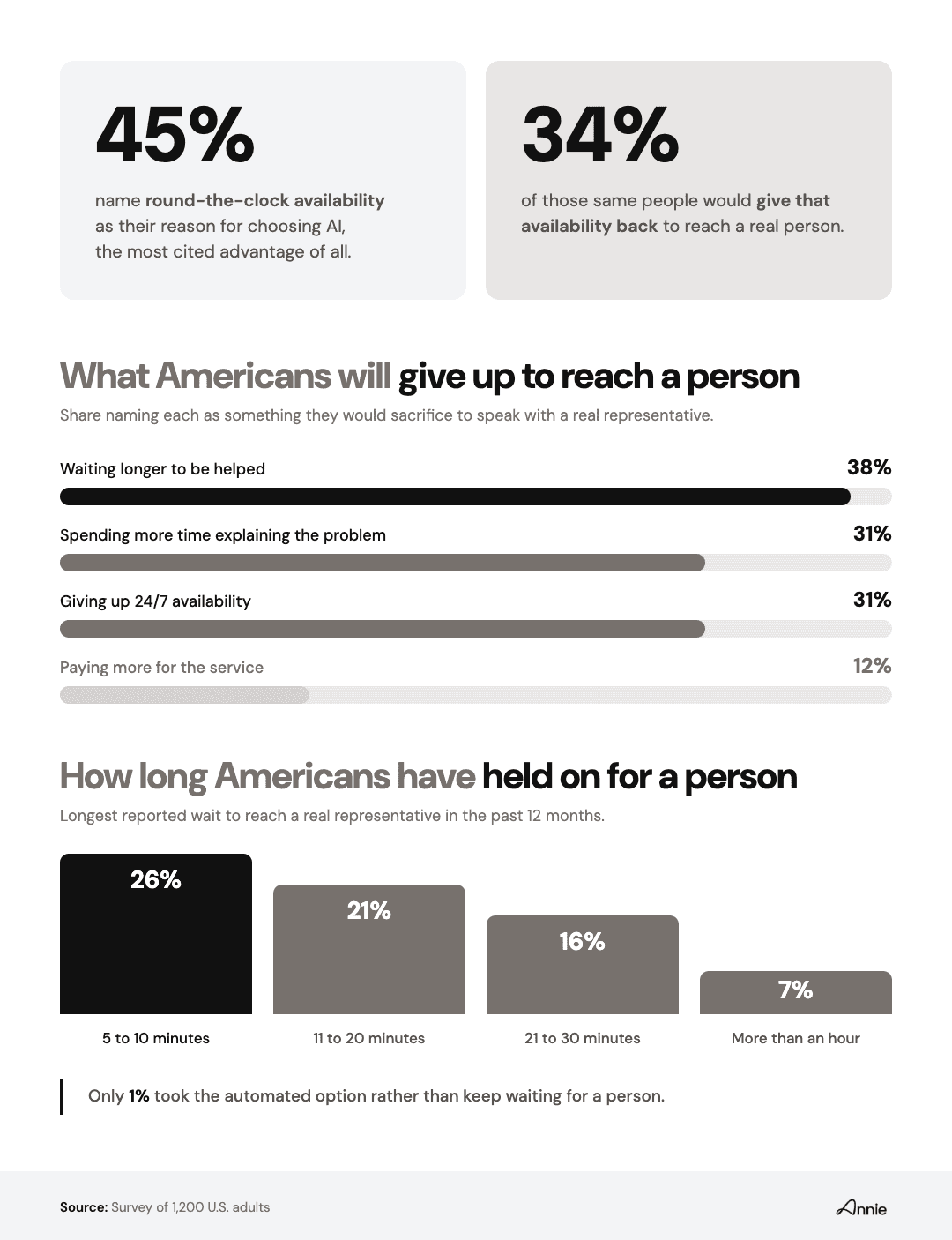
Americans absorb real time to reach a person, and they do it without much visible complaint. Five to ten extra minutes is the most commonly reported, at 26%, but 21% have waited 11 to 20 minutes, 16% have waited 21 to 30, and 7% have held on for more than an hour. Almost nobody gives up: only 1% say they took the automated option rather than keep waiting. Once someone decides they want a human, the shortcut right in front of them goes almost entirely unused, making the wait less a matter of tolerance than commitment. Waiting longer is also the sacrifice Americans name most readily, at 38%, ahead of spending more time explaining themselves and giving up 24/7 availability, both at 31%.
Money turns out to be nearly irrelevant. Just 12% would pay more to reach a person, and 13% cite lower cost as a reason to accept AI, a virtual tie that pushes both near the bottom of their respective lists. Willingness to pay also runs backward from where you’d expect. Gen Z is nearly five times more likely than Boomers to open a wallet for human contact, 19% versus 4%, even though Boomers want the human far more urgently. Younger Americans appear to have learned to treat access to a person as a paid tier rather than a default.
The contradiction sits at the center of everything. Round-the-clock availability is the most cited reason Americans choose AI in the first place, named by 45% and well ahead of saving time at 29%. Yet among the 525 people who named that exact advantage, 34% would give it back to reach a human. They are not confused. Availability solves the problem of when help arrives, but it does nothing about who provides it, and when those two collide, people trade away the convenience they said they valued most.
What People Do When Help Isn’t There
Every business keeps a dashboard for the customers who complain. Reviews get counted, and refunds show up in the numbers by month’s end. The most common thing an unreachable customer does leaves no record anywhere. They stop trying, and nobody at the company ever finds out. Why people quit an AI tool matters as much as what quitting costs, and the reasons come down to competence. Machines lost customers by failing at the task, not by making anyone uneasy about privacy or technology. Who gives up fastest also cuts against every assumption about age and tech fluency.

Giving up outranks every visible consequence tested, and it isn’t close. 35% of Americans have abandoned an issue entirely because they couldn’t reach a person, against 21% who abandoned an online purchase, 21% who canceled an appointment, 19% who told someone about the experience, 15% who switched providers, and 14% who left a negative review. Those actions all leave a trace a business can count. Walking away leaves nothing, which means the most common cost of an unreachable front desk never reaches the people who could fix it.
What drives someone to a human in the first place is simpler than the automation debate usually allows. Competence failures dominate: 43% have quit an AI tool because it couldn’t solve the problem and 39% because it couldn’t understand what they needed, followed by 25% who got incorrect information and 24% who had to repeat themselves. Privacy barely registers, and the need for reassurance or empathy registers even less, at 8%. Americans aren’t rejecting machines on principle or recoiling from them emotionally. They leave when the machine doesn’t work, which means the fix is functional rather than persuasive.
Boomers complicate the assumption that older customers struggle with automation. Only 25% have walked away from an unresolved issue, 16 points below Millennials at 41%, with Gen Z at 37% and Gen X at 35% clustered near the top. Set that against their behavior elsewhere, wanting a human most urgently and willing to wait longest to get one, and a clear profile emerges. Boomers don’t quit. For a practice with an older patient panel, that turns an unreachable front desk into a staffing problem rather than a churn problem, because those patients stay on the line until someone picks up.
Which is Better? Humans vs. AI
Americans have already worked out the division of labor, and they describe it with unusual precision. Machines own the clock. Anything that requires reading a situation or carrying the blame for getting it wrong belongs to a person. Abstract ratings flatter whichever side a respondent already favors, so the sharper test comes from naming actual jobs. Asked who should cook their dinner or handle a stolen identity, Americans answer without much hesitation. The tasks people guard most closely have less to do with difficulty than with consequence. And when a machine gets something wrong, the damage outlasts the incident.
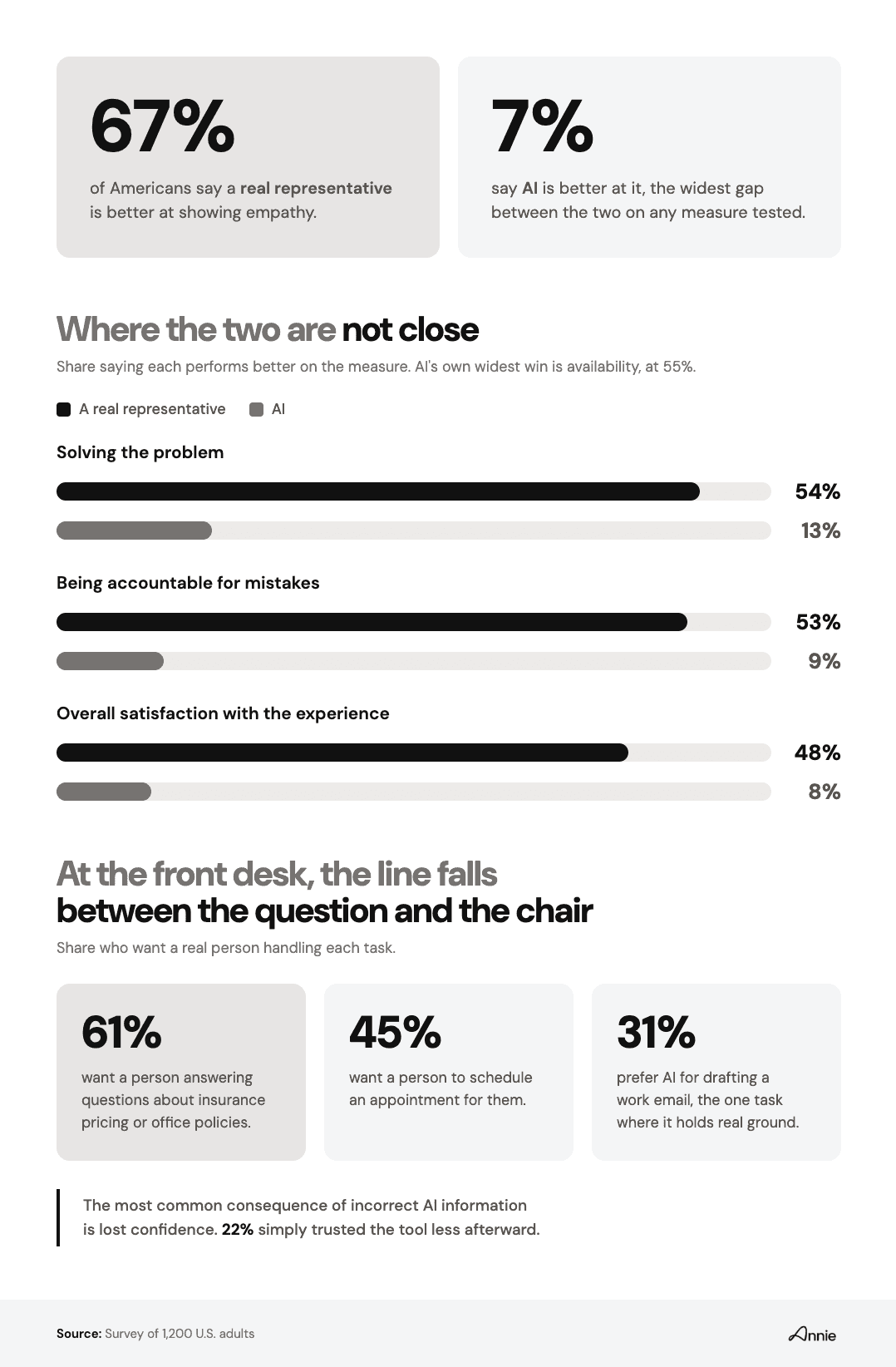
AI takes the dimensions of when help arrives. Availability is its widest win at 55%, with saving time behind it at 40%. Everything else belongs to people, and the margins are not close: humans lead on empathy 67% to 7%, on solving problems 54% to 13%, on accountability for mistakes 53% to 9%, and on overall satisfaction 48% to 8%. Simple questions mark the boundary, the one place where neither side wins, with 47% calling the two about equal. That’s the territory AI has genuinely taken, and it maps almost exactly onto the tasks Americans already hand over without thinking.
Naming actual jobs sharpens the picture that abstract ratings blur. The tasks people guard most fiercely aren’t the technically hardest ones. Cooking a restaurant meal tops the list at 81%, and driving sits at 75%, neither of them complex, alongside suspected fraud or identity theft at 78% and emotionally sensitive issues at 76%. What unites them is exposure. Each carries a consequence that falls on the customer rather than the company, which is why work email, where a mistake costs little and gets caught before it matters, is the only task where AI holds real ground, with 31% preferring it. Closer to a dental practice, 61% want a person answering questions about insurance pricing or office policies, and 45% want one to schedule an appointment.
Errors do lasting damage. The most common consequence of incorrect AI information is neither a wasted afternoon nor a call to fix it. 22% simply trusted the tool less afterward, ahead of the 19% who contacted customer service and the 18% who lost time on corrections. Every other consequence resolves once the problem gets solved, while diminished confidence follows the customer into every future interaction. A dental practice absorbs that cost twice, since the patient who stops trusting the automated system starts calling the front desk for things the system could have handled.
Where Americans Are Drawing the Line for AI's Future
A machine that can pass for a person has cleared a threshold engineers spent decades chasing. Americans have noticed, and a sizable share have already mistaken one for a human being. Getting fooled has not landed as a party trick; more people left unsettled than pleased. Blending in and being welcome are different achievements. Americans hold firm opinions about which jobs a machine may touch, and those opinions have little to do with how complicated the work is. What decides the matter is who absorbs the damage when something goes wrong, which puts a customer support queue and a courtroom sit at opposite ends of the same calculation.

AI has cleared the believability threshold, and Americans are ambivalent about the achievement. 36% have already been fooled, and 23% expect the line to keep blurring. Among the people it actually happened to, 44% were bothered against 23% who preferred the experience, with 37% indifferent. Passing for human turns out to be a technical milestone that customers experience as a small betrayal, which is a distinction worth sitting with before a business decides seamlessness is the goal.
Loyalty is already moving in both directions. 19% of Americans have left a company over its reliance on AI, 15% have chosen one because of it, and 15% have done both at different times. The two-way movement matters more than the totals, because it means AI functions as a live variable in purchasing rather than a settled liability or asset. A slim majority, 54%, still reports no effect either way, so the shift is real without being universal.
What Americans permit has surprisingly little to do with what a job requires. Childcare and judges top the protect list, at 68% and 66% saying AI should have no role at all, but pilots follow at 61%, then therapists at 59% and rideshare drivers at 58%, all ranked above nurses at 51%, lawyers at 50%, and doctors at 49%. Physical custody seems to be the organizing principle rather than credentials or technical difficulty, since Americans guard the person steering the care more closely than the one writing the prescription. Dentists land at 56%, solidly protected, which reads less as a rejection of automation in dental practices than as a boundary drawn around the chair itself. Customer support sits at the opposite end, the one role a clear majority is comfortable handing over, at 75%, and it happens to be the work a front desk actually does.
Why the Handoff Decides Everything
The argument over customer service automation is usually framed as a contest: machines on one side and people on the other. Americans don't seem to see it that way. They hand over the routine willingly and save their insistence for moments that carry weight. The line they draw is practical rather than ideological, and they draw it with more care than either side of the debate tends to credit.
That distinction changes what a business should worry about. Automation rarely fails because customers reject it outright. It fails when someone needs to step out of it and finds no way through, and the cost of that failure stays nearly invisible because people who cannot reach help usually stop asking rather than complaining. Practices that treat the handoff as an afterthought end up measuring the wrong thing when they count deflected calls.
The encouraging part is this is a design problem with a known solution. A front desk can let a machine handle confirmations and reminders while keeping a fast, obvious path to a person for everything else, and patients reward exactly that arrangement. Annie’s approach to dental phone coverage rests on the same premise, treating automation as something that protects staff time rather than something that stands between a patient and the people who care for them. The practices that get this right will be the ones whose patients never have to wonder whether a person is still there.
Methodology
Annie surveyed 1,200 U.S. adults in September 2026 to measure when Americans rely on automation, when they seek out human involvement instead, and what they've sacrificed, whether time, money, convenience, or provider loyalty, to reach a real person. The survey focused on reported behavior over the past 12 months rather than abstract predictions or hypotheticals. Results were post-stratified and analyzed across demographic segments including generation (Gen Z, Millennials, Gen X, Baby Boomers) and gender. Percentages reflect self-reported data and may exceed 100% when multiple selections were allowed.
About Annie
Annie is an AI-powered front desk assistant built specifically for dental practices, answering patient calls around the clock and booking appointments through direct integration with major practice management software. The company positions its technology as an extension of the front office rather than a replacement, taking routine calls so staff stay available for patients who need a person. That division of labor, automation for the routine and people for everything else, is the boundary American patients say they want.
Fair Use Statement
The information in this article may be shared for non-commercial purposes only. If you reference these findings, please credit Annie and include a link with proper attribution back to this original research.
