The Modern Dental Front Desk Maturity Model: Where Does Your Practice Stand?

The Modern Dental Front Desk Maturity Model: Where Does Your Practice Stand?
Every dental practice wants: a better front desk, fewer missed calls, less chaos, happier patients, and a team that isn't constantly playing catch-up. But "better" means different things to different practices.
Some offices are still relying on sticky notes and voicemail. Others have online scheduling, automated reminders, and AI helping answer patient questions.
So how do you know where your practice stands? More importantly, how do you know what the next step should be?
That's why we created the Modern Dental Front Desk Maturity Model. It's a framework for understanding how today's leading practices are evolving the front desk from a reactive administrative function into one of the biggest drivers of patient experience and practice growth.
Whether you're just beginning to modernize or already embracing AI-powered workflows, this guide will help you identify where your practice is today and where it's headed next.
What Is the Modern Dental Front Desk Maturity Model?
The Modern Dental Front Desk Maturity Model is a five-level framework that measures how effectively a dental practice manages patient communication and front desk operations.
Unlike traditional practice management advice, this model focuses on one question: How easy is it for patients to do business with your practice?
Every level builds on the one before it.
As practices mature, they don't replace people. They simply remove friction.
The result is better patient communication, happier teams, and a more consistent patient experience.
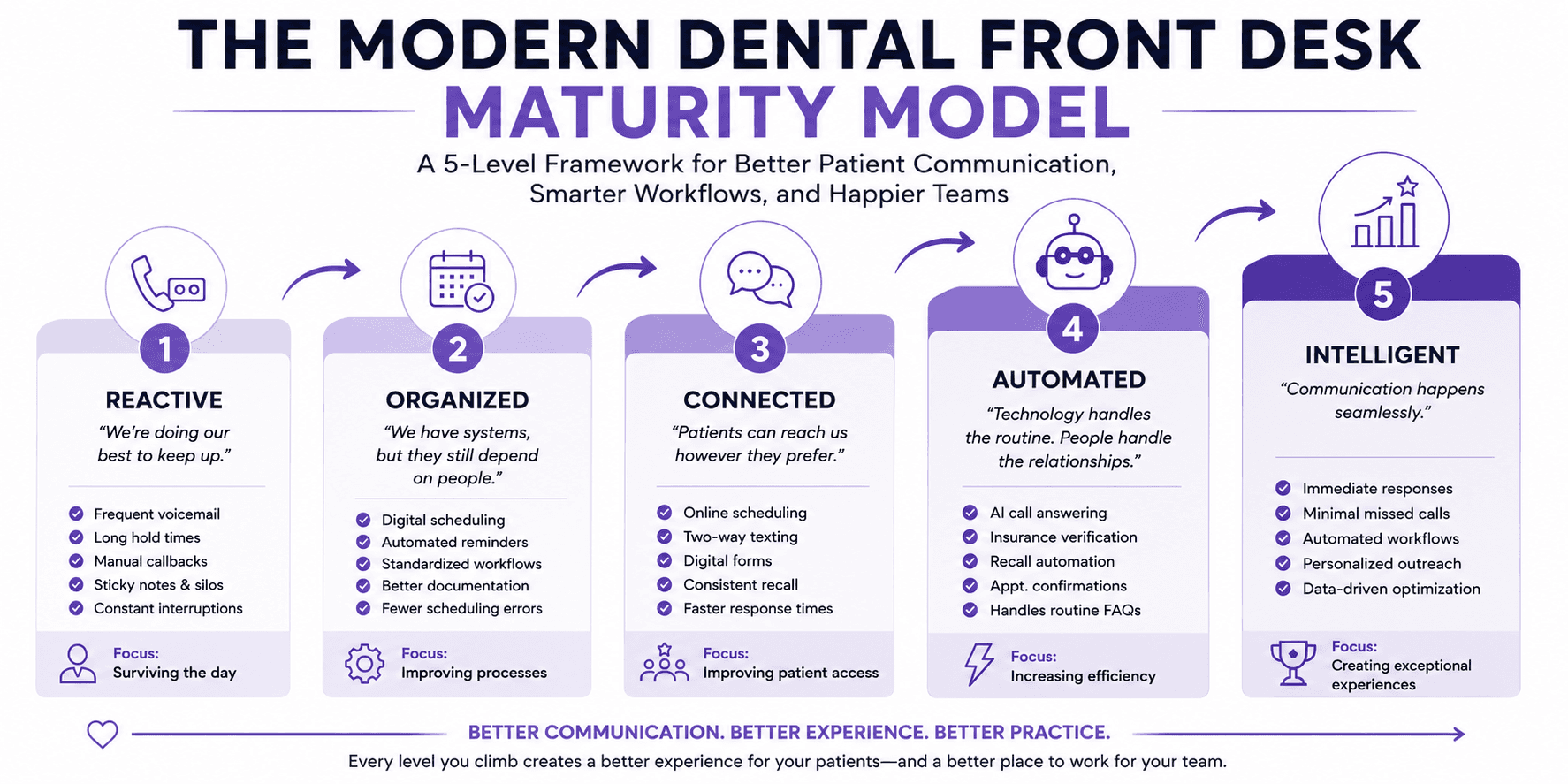
Level 1: Reactive
"We're doing our best to keep up." At this stage, the front desk spends most of the day reacting.
The phone rings.
Patients walk in.
Insurance questions come up.
Schedules change.
Everything feels urgent.
Common characteristics include:
Frequent voicemail
Long hold times
Sticky notes and handwritten reminders
Manual callbacks
Appointment books filled by phone
Front desk staff constantly multitasking
None of these practices are signs of a bad team. They're signs of a team that's overloaded.
The Patient Experience
Patients may experience:
Long wait times on the phone
Missed calls
Delayed callbacks
Inconsistent communication
The Next Step
Start documenting repeatable processes and identify the administrative tasks that consume the most time each week.
Level 2: Organized
"We have systems, but they still depend on people." Practices at Level 2 have improved organization.
They've introduced technology to support the team, but most communication still relies on staff availability.
Typical characteristics include:
Digital scheduling software
Automated appointment reminders
Standardized workflows
Better documentation
Fewer scheduling errors
This stage often feels significantly better than Level 1, but bottlenecks still appear whenever the office gets busy.
The Patient Experience
Patients receive more consistent communication, but may still encounter:
Hold times during busy periods
Delayed responses
Limited after-hours support
The Next Step
Identify where patients experience the most friction. Communication is usually the first opportunity for improvement.
Level 3: Connected
"Patients can reach us however they prefer." Communication becomes a strategic priority.
Rather than relying solely on phone calls, practices create multiple convenient ways for patients to connect.
Common capabilities include:
Online scheduling
Two-way texting
Digital forms
Automated confirmations
Consistent recall communication
Faster response times
Communication starts feeling proactive instead of reactive.
The Patient Experience
Patients feel like the practice is responsive, organized, and easy to work with.
The Next Step
Reduce the amount of repetitive communication your front desk handles manually each day.
Level 4: Automated
"Technology handles the routine. People handle the relationships." This is where many of today's fastest-growing dental practices are heading.
Instead of asking front desk teams to manage every repetitive task themselves, automation begins handling routine communication.
Examples include:
Appointment scheduling assistance
AI-powered phone answering
Insurance verification workflows
Recall outreach
Appointment confirmations
Frequently asked patient questions
Solutions like Annie help practices reach this stage by becoming an extension of the front desk, not replacing it.
Instead of spending hours answering repetitive calls, teams gain more time to welcome patients, coordinate care, and solve the conversations that truly require a human touch.
The Patient Experience
Patients experience:
Faster answers
Shorter hold times
Better availability
More consistent communication
A smoother scheduling experience
The Next Step
Shift your team's focus from administrative work to relationship-building.
Level 5: Intelligent
"Communication happens seamlessly." At the highest level of maturity, patient communication becomes a competitive advantage.
Technology quietly handles routine interactions while your team focuses almost entirely on delivering exceptional patient experiences.
Characteristics include:
Immediate responses across communication channels
Minimal missed calls
Automated routine workflows
Personalized communication
Predictable patient follow-up
Continuous optimization using communication data
The front desk becomes less about processing tasks and more about creating memorable experiences.
The Patient Experience
Patients describe the practice as:
Easy to reach
Organized
Responsive
Professional
Modern
Communication feels effortless.
Why Most Practices Get Stuck
Many dental practices remain at Levels 1 or 2. Not because they lack great people, but because they're asking those people to manage an impossible amount of work.
The average front desk is expected to:
Answer every phone call
Check patients in
Schedule appointments
Verify insurance
Collect payments
Respond to texts
Manage recalls
Handle emergencies
Eventually something has to wait, and it's usually communication.
Modern practices aren't solving this by hiring endlessly. They're redesigning how work gets done.
Communication Is the Common Thread
As you move through each maturity level, one pattern becomes clear: Every improvement starts with communication.
Better communication leads to:
More scheduled appointments
Better patient experiences
Higher retention
Better reviews
Less stress for staff
More efficient operations
That's why communication is often the first place leading practices invest when modernizing their front desk.
Where Annie Fits
Annie was built to help practices move up the maturity curve.
By answering calls, assisting with scheduling, supporting patients after hours, helping with recall, and handling routine patient conversations, Annie allows front desk teams to spend less time reacting and more time building relationships.
The goal isn't to replace your people. It's to remove the repetitive work that prevents great people from delivering exceptional experiences to patients.
For many practices, Annie has become the bridge between an organized front desk and an intelligent one.
Where Is Your Practice Today?
Every dental practice starts somewhere. The goal isn't to jump from Level 1 to Level 5 overnight. The goals is to identify your next step.
Ask yourself:
Are patients waiting on hold?
Are calls being missed?
Is your front desk constantly interrupted?
Are repetitive administrative tasks consuming your team's day?
Do patients receive consistent communication before, during, and after every visit?
Your answers will tell you where your practice stands and where the biggest opportunities for improvement exist.
Our Final Thoughts
The dental front desk is changing. The practices leading the industry aren't necessarily hiring more people, they're building better systems.
The Modern Dental Front Desk Maturity Model isn't about replacing human connection with technology, it's about using technology to make human connection possible.
As patient expectations continue to rise, practices that modernize their communication, reduce administrative burden, and empower their front desk teams will be the ones that stand out.
The future of the dental front desk isn't measured by how many tasks your team can juggle. It's measured by how effortlessly your practice makes every patient feel cared for.
