The Senior's Guide to Dental Care: Medicare, Medicare Advantage & Affordable Options

The Senior's Guide to Dental Care: Medicare, Medicare Advantage, and Affordable Options
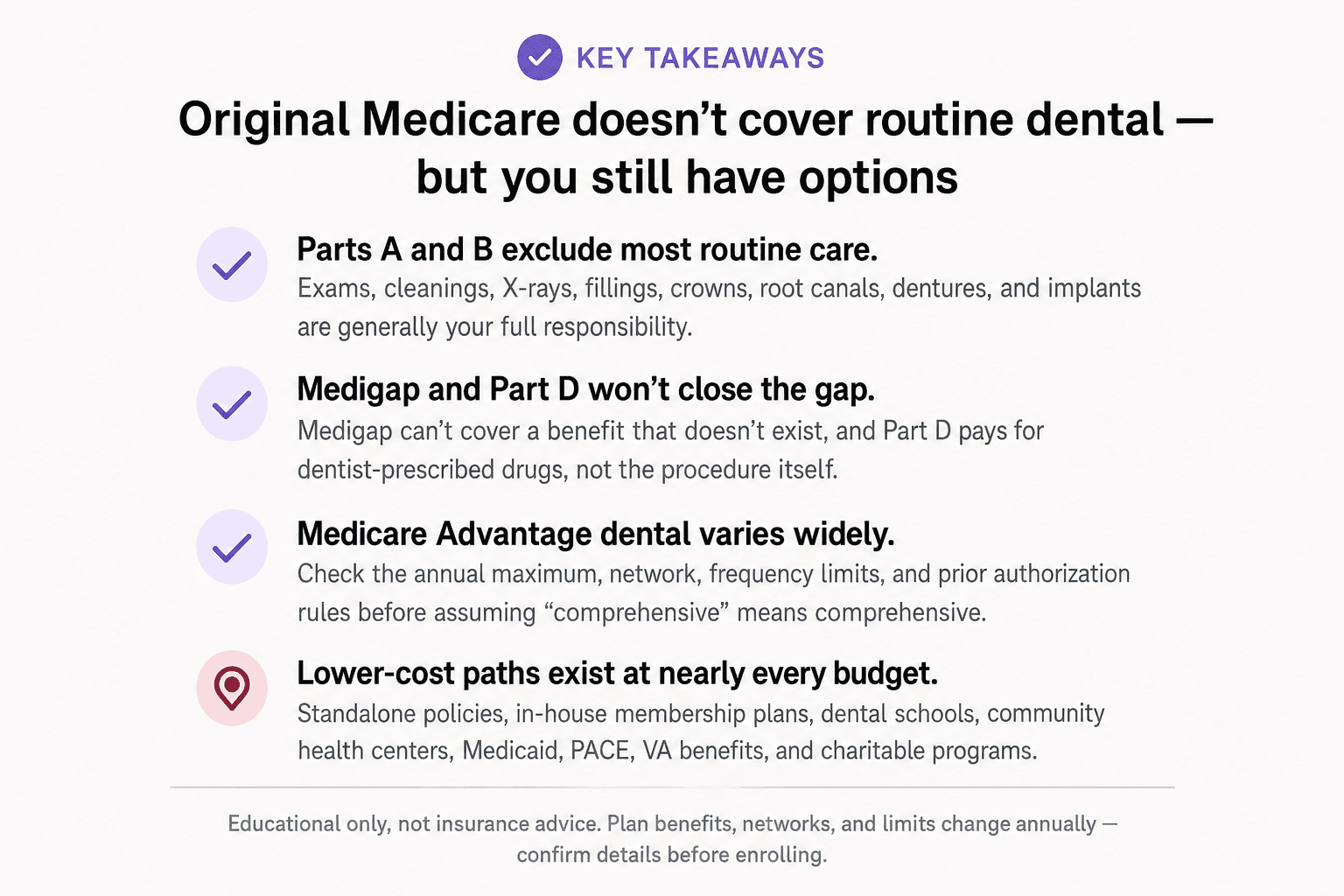
Many people first discover that Medicare doesn’t cover routine dental care at the worst possible moment: sitting in the dentist’s chair with a treatment plan in hand. It’s an unwelcome surprise at any age, but it can feel especially unfair in retirement, when your budget may be tighter just as your teeth begin needing more attention.
If this has happened to you or someone you care for, you haven’t missed an obvious enrollment step. We know how frustrating it is to learn about a major coverage gap only after care is needed, often when your previous employer coverage has now ended. Original Medicare excludes most routine dental services, but other forms of coverage, discounted care, and safety-net programs can make treatment more manageable at nearly every budget level.
This guide is educational and not insurance advice. Medicare Advantage benefits, provider networks, premiums, and coverage limits can change each year, so confirm the details of a specific plan before enrolling or scheduling care.
Oral Health Concerns That Change with Age
The frustrating part is that dental coverage often becomes harder to find just as oral health needs become more of a priority. While there is no expiration date on your teeth (getting older doesn’t mean you automatically lose them), decades of wear, previous dental work, medication effects, and chronic conditions can take their toll by your golden years. Fortunately, many of the dental problems associated with aging can still be prevented, treated, or managed.
Dry mouth is one of the most common troublemakers, and it’s more than an annoying need to keep more water nearby. Saliva acts as your mouth’s cleanup crew. It washes away food particles, buffers acids, and helps repair early enamel damage. However, according to the National Institute of Dental and Craniofacial Research, dry mouth isn’t a part of aging. As such, it shouldn’t be something to shrug off. Instead, you may want to look at other factors, such as any prescription medications. For example, many medicines taken by older adults can reduce saliva, leaving teeth more vulnerable to decay. Receding gums add another risk by exposing root surfaces, which don’t have the same hard enamel protection as the crowns of teeth.
Don’t stop a prescription because you suspect it’s causing dry mouth. Ask a physician, dentist, or pharmacist to review your medications and possible alternatives. Drinking water regularly, using sugar-free xylitol gum or lozenges when appropriate, and trying a saliva substitute may help. A dentist may also recommend prescription-strength fluoride for extra protection. Persistent dry mouth deserves attention, not acceptance.
Tooth Loss, Dentures, and Caregiving Barriers
If you are missing teeth, you may have more options than you realize. Removable dentures, bridges, and dental implants can all restore some function, but there is no universally “best” choice. Your bone health, remaining teeth, dexterity, medical history, budget, and ability to care for the restoration all belong in the conversation.
While dentures may be an option for you, they are not a “fit them and forget them” solution. Your jaw and gums change over time, so a set that once felt comfortable may begin slipping, rubbing, or making meals miserable. Don’t assume sores, bleeding, or ongoing pain are part of wearing dentures. A dentist can check the fit and determine whether an adjustment, reline, or replacement would help. Severe swelling, uncontrolled bleeding, facial trauma, or trouble breathing or swallowing call for more urgent help from an emergency dentist.
A poor fit can affect more than your comfort. When chewing hurts or takes too much effort, the menu quietly starts shrinking. Crisp vegetables, nuts, meat, and other nutritious foods may give way to whatever feels easiest to eat. Replacing teeth isn’t just about a better smile. Comfortable, well-fitting dentures can make it easier to eat, speak, and enjoy meals with other people again.
Even if you no longer have any natural teeth, your dentist still has an important role to play. Regular visits allow them to monitor how your dentures fit, check the health of your gums and other soft tissues, and look for early signs of oral cancer. Between appointments, pay attention to sores, lumps, thick patches, numbness, or swallowing problems that last longer than two weeks. If you notice any of these issues or changes, you’ll want to schedule an appointment with your dentist to have them evaluated.
Of course, knowing that ongoing care matters doesn’t make it easier to arrange. Caregivers often face barriers that have little to do with motivation. Transportation, memory loss, physical disability, dental anxiety, and limited hand strength can turn a routine appointment into a complicated project. Before scheduling, caregivers can ask whether the practice offers:
Wheelchair-accessible rooms;
Longer appointments;
Caregiver participation;
Treatment for people with cognitive or physical limitations.
Mobile dental services may also be available through local health systems, senior programs, or long-term care communities. Finding a practice that understands the situation can make a meaningful difference in the dental patient experience.
The Link Between Oral Health and Chronic Conditions
Those practical barriers matter because a dental problem rarely stays neatly confined to one tooth. Your mouth affects how you eat, sleep, manage health conditions, and feel from day to day. Still, not every mouth-body connection works the same way. Some are well established, while researchers are still untangling others, so it helps to separate useful guidance from dramatic claims.
Diabetes offers one of the clearest examples of how oral and overall health can affect each other:
High blood glucose may make infections and gum inflammation harder to control.
Periodontal inflammation may make blood glucose more difficult to manage.
Because the two conditions can aggravate each other, don’t wait until your next routine visit to mention bleeding, swelling, loose teeth, or a change in how your dentures fit. Leaving these problems untreated can have significant impacts. Nearly 25% of adults with diabetes in the U.S. over the age of 50 suffer from severe tooth loss.
The connection between your mouth and heart health requires more caution. You may have heard the blunt claim that gum disease causes heart attacks, but the research isn’t that simple. Gum disease and cardiovascular disease are associated, yet scientists haven’t proved that one directly causes the other. Caring for your mouth still supports comfort, infection control, nutrition, and quality of life. It just shouldn’t come with promises that the evidence doesn’t support.
For frail older adults and people who have difficulty swallowing, however, poor oral health can create a more immediate risk. Without regular cleaning, harmful bacteria can build up in the mouth, where they may be inhaled into the lungs and contribute to aspiration pneumonia. If someone can’t manage their own oral care, caregivers can help twice a day by cleaning:
Natural teeth
Dentures
Gums
The tongue
The person’s dental and medical teams can provide additional guidance based on their health and swallowing needs.
These health connections make dental care more than routine upkeep. Delaying treatment can affect eating, sleep, chronic-condition management, and the ability to enjoy daily life. Removing practical barriers and preventing missed dental visits can support much more than a healthy smile.
Why Dental Coverage Gets Harder in Retirement
Unfortunately, understanding the importance of dental care doesn’t solve the question of how to pay for it. Retirement changes plenty of routines, and losing employer-sponsored dental coverage may be one of the less pleasant surprises. Original Medicare steps in for much of your medical care but leaves routine dentistry behind. That gap may send you looking at former employer coverage, a separate policy, Medicare Advantage benefits, Medicaid, or local assistance.
If you’re caught in that gap, you have plenty of company. A KFF analysis found that in 2019, 47% of Medicare beneficiaries, or nearly 24 million people, had no dental coverage.
At the same time, going without coverage doesn’t make the need for care disappear. The CDC’s 2024 surveillance report found that nearly 13% of adults 65 and older with at least one natural tooth had untreated decay. The burden wasn’t shared equally. Untreated decay was far more common among several groups, including people with lower incomes and less education, and non-Hispanic Black and Mexican American older adults. Complete tooth loss also remains more common among older adults with lower incomes or less formal education.
That combination of limited coverage and ongoing need creates a frustrating snowball effect. You postpone a cleaning or small filling because money is tight, the tooth gets worse, and suddenly you are facing an emergency and a much larger bill. Coverage can help interrupt that cycle, but it isn’t the only tool. Asking about prices early, requesting a written treatment plan, and exploring community programs can give you choices before pain decides for you.
What Original Medicare Does and Doesn't Cover
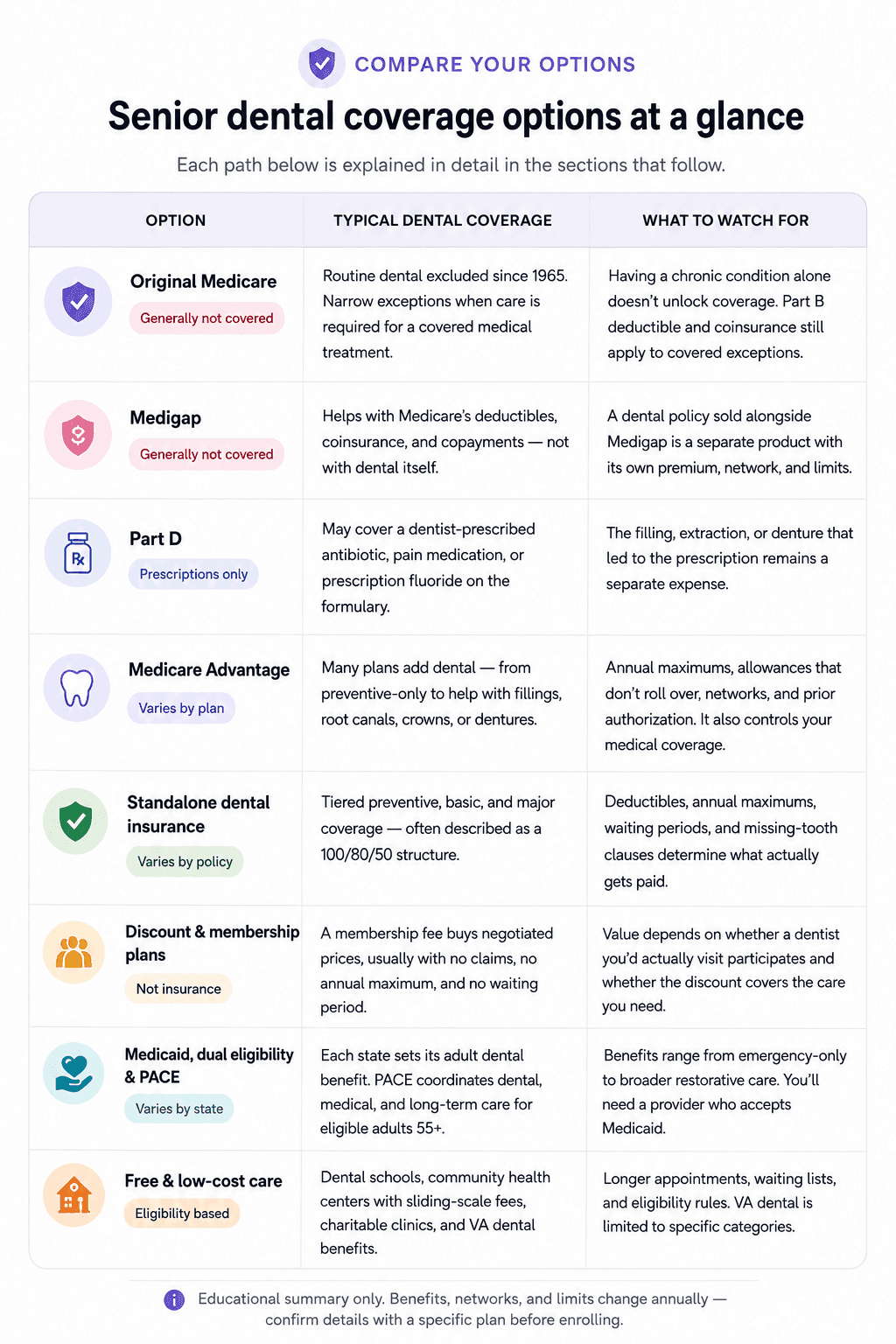
Understanding what Original Medicare covers is a good place to start because its limitations shape which other coverage options may be worth considering. The short version isn’t encouraging. Parts A and B don’t cover most routine dental care. That usually leaves you responsible for the full cost of exams, cleanings, X-rays, fillings, crowns, bridges, root canals, extractions, dentures, and implants.
This isn’t a small benefit that accidentally slipped through the cracks. Federal law has excluded most dental care since Medicare began in 1965. That history explains why the gap exists, but it doesn’t make the bill any less frustrating when you need a crown or a new set of dentures today.
The Exceptions
Although routine care is excluded, the door isn’t completely closed to all coverage. The exceptions sound technical, but the basic idea is simpler. Medicare may cover dental care when it’s necessary for another covered medical treatment to succeed. That can include certain oral exams and treatment before a heart valve procedure, organ or bone marrow transplant, or some cancer treatments. Specified dental services may also qualify when connected to head and neck cancer care or dialysis for end-stage renal disease. The dental service must be tied to the covered medical care, and your medical and dental providers need to coordinate and meet Medicare’s requirements.
The connection requirement between medical and dental creates an important catch. Having diabetes, heart disease, or another chronic condition doesn’t automatically unlock routine dental coverage. The dental service itself has to fit one of Medicare’s specific covered circumstances, and Part B deductibles and coinsurance generally still apply to covered outpatient care.
Inpatient care adds another layer. Part A may cover a hospital stay when a person’s underlying medical condition or the severity of a dental procedure requires it, but coverage for the hospital doesn’t automatically extend to every dental service performed there. Whenever possible, ask the hospital, treating dentist, and Medicare how each part of the care will be billed before treatment begins.
Why Medigap and Part D Won't Fill the Gap
Once people discover the coverage gap, Medigap may seem like the natural place to look next. It can help with some of Original Medicare’s deductibles, coinsurance, and copayments, but it can’t fill a benefit that doesn’t exist. If Original Medicare doesn’t cover your routine dental care, Medigap generally won’t cover it either. An insurer may offer a separate dental policy alongside Medigap, but that policy is its own product with a separate premium, network, exclusions, and limits.
Part D helps at a different point in the treatment process. Because it covers prescription drugs rather than dental procedures, a plan may pay for a dentist-prescribed antibiotic, pain medication, or prescription fluoride when the drug appears on its formulary and meets its other rules. The filling, extraction, denture, or other procedure that led to the prescription remains a separate expense.
Medicare Advantage Dental Benefits
If neither Medigap nor Part D solves the problem, Medicare Advantage can look like the obvious answer. Also called Part C, these private plans provide your Part A and Part B benefits, and many add dental coverage. As of 2026, most Medicare Advantage enrollees are in a plan with some dental benefit. The keyword here is “some”. A benefit can appear impressive in a brochure and feel much smaller when it’s time to use it.
What “some” means varies widely. One plan may cover exams, cleanings, and X-rays with little or no in-network cost sharing. Another may help with fillings, extractions, root canals, crowns, or dentures, but leave you paying a percentage of the bill. Even then, annual limits, rules about how often you can receive a service, and prior authorization can shrink the value of the benefit.
The annual maximum is often where the brochure meets reality. A $1,500 benefit sounds generous right up until one crown or partial denture consumes most of it. Some plans instead use a flat allowance that works more like a spending card. That structure may offer more flexibility, but only for eligible services and providers. Unused dollars typically don’t roll over, and next year’s benefit may not look like this year’s.
More importantly, the dental benefit is only one part of the plan. Medicare Advantage also controls your medical coverage, so a shiny allowance shouldn’t make the entire decision for you. Before switching, check your doctors, hospitals, prescriptions, referral rules, and total out-of-pocket risk. Saving on cleanings will not feel like a win if the plan makes the rest of your healthcare harder or more expensive.
How to Compare Plans Before You Enroll
With that bigger picture in mind, start your comparison with the Medicare Plan Finder, but don’t stop at the colorful summary.
Open each plan’s Evidence of Coverage and look for the less glamorous details:
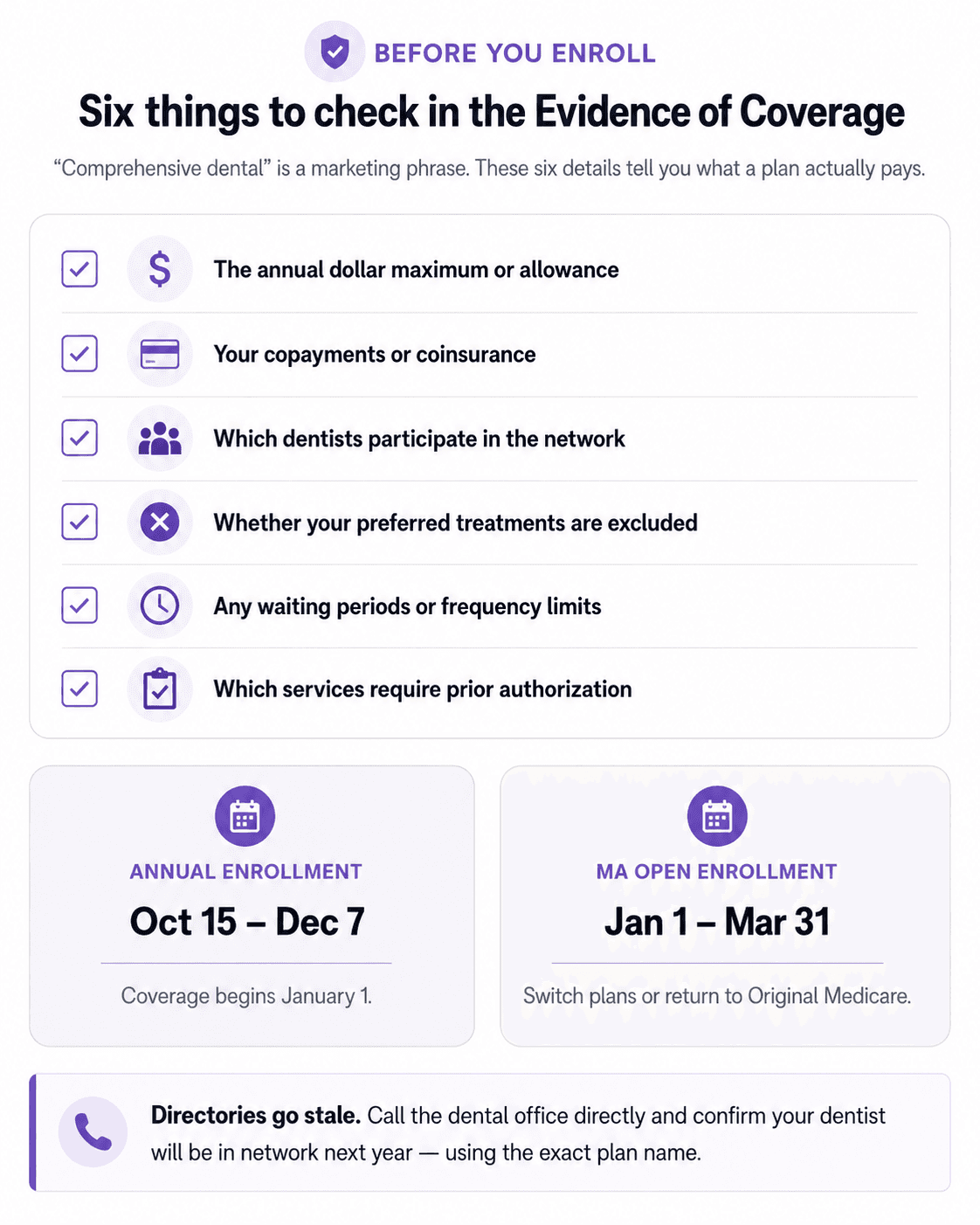
Although you may see phrasing like “comprehensive dental,” it is a marketing phrase, not a complete explanation of coverage. Once you parse through the details and find a promising plan, timing determines when you can act. Medicare’s annual enrollment period runs from October 15 through December 7 for coverage beginning January 1. If you are already enrolled in Medicare Advantage, you can use the Medicare Advantage open enrollment period from January 1 through March 31 to switch to another Medicare Advantage plan or return to Original Medicare. Certain life events may create other enrollment opportunities, so check Medicare’s current enrollment rules before making a change.
Enrollment dates are only part of the homework. Because provider directories may be outdated, call the dental office to confirm that your dentist will be in network for the coming year, using the exact plan name. A responsive dental answering service can make getting those details easier. If comparing documents, costs, and enrollment rules still feels overwhelming, a local State Health Insurance Assistance Program counselor can provide free, unbiased guidance without trying to sell you a plan.
Standalone Dental Insurance for Seniors
Medicare Advantage isn’t the only way to buy dental coverage. A standalone policy can be a good fit if you want predictable preventive benefits, are comfortable using an in-network dentist, and plan to keep the policy long enough to benefit from it. Just resist choosing based on a neat percentage chart alone. A “100/80/50” plan might pay 100% of preventive care, 80% of basic work, and 50% of major services, but deductibles, annual maximums, and exclusions still determine what the plan actually pays.
That is why the monthly premium is only the cover charge. Some policies make you wait before they cover major work. Others have a missing-tooth clause, which may exclude a bridge or implant for a tooth you lost before the policy began. A plan can therefore look affordable and still pay nothing toward the treatment you need most, even while helping with future cleanings and fillings.
The best comparison starts with your mouth, not the policy brochure. If possible, get an exam and a written treatment plan before you shop. Once you know what care may be ahead, add the annual premiums and deductibles, estimate your share, and compare that total with the policy’s maximum and exclusions. Ask the dentist for both the in-network fee and the cash price. Sometimes insurance saves money. Sometimes the math says otherwise.
Discount Plans, Membership Plans, and Other Alternatives
If the insurance math doesn’t work out, a discount plan may offer a simpler alternative. It’s not insurance, but that doesn’t make it useless. You pay a membership fee to receive negotiated prices from participating dentists, usually without claims, annual benefit maximums, or long waits for coverage to begin. Its value comes down to two practical questions: Does a dentist you would actually visit participate, and does the discount apply to the care you need?
You may not have to look beyond your current dentist for a similar arrangement. Some practices offer an in-house membership plan that includes exams and cleanings for a yearly fee, plus discounts on other services. With no insurance company in the middle, these plans can be refreshingly simple. The trade-off is that their value is tied to one practice, so make sure it’s an office you trust and want to keep using.
Even with a discount, you may still have a balance to cover. Existing HSA funds can generally be used tax-free for qualified dental expenses, although you can no longer contribute to an HSA beginning with the first month of Medicare enrollment. Financing can close another part of the gap, but this is where you should read the fine print with your glasses on. With deferred-interest offers, missing the payoff deadline may trigger interest all the way back to the purchase date. Before signing, calculate a monthly payment that fits comfortably into your real budget.
Free and Low-Cost Dental Care for Seniors
Even careful planning can’t make every treatment affordable. If the remaining cost is still out of reach, that is not a personal failure or proof that you planned poorly. Fixed incomes, insurance gaps, provider shortages, and transportation barriers can make perfectly ordinary care inaccessible. At that point, widen the search beyond traditional insurance. A dental school, community clinic, public program, or charitable organization may offer a more workable route.
Dental schools are often a useful first call because they can provide high-quality, supervised care at a lower cost. Students treat patients under licensed faculty supervision, while advanced clinics may use residents. The primary trade-off is time. Appointments often run longer because instructors carefully review each stage. If your schedule has some flexibility, those extra hours may put a larger treatment plan within reach.
If a dental school is too far away or has a long wait list, try a community health center next. Many offer dental services and adjust fees based on income and household size, although the care available differs by location. Use the HRSA Find a Health Center Tool to locate nearby clinics, then call to ask what services they provide, what documents to bring, how fees work, how long the wait is, and whether they reserve appointments for urgent problems.
Medicaid, Dual Eligibility, and PACE
Public benefits may open another door, particularly if you have limited income or need help continuing to live safely and independently at home. Medicaid dental coverage can feel like a ZIP-code lottery because each state decides which adult services to cover. Benefits range from emergency-only care to broader preventive and restorative treatment. If you have both Medicare and Medicaid, Medicare’s dental exclusion doesn’t necessarily end the conversation. Medicaid may provide benefits that Original Medicare doesn’t. You’ll need to find a dental provider that accepts Medicaid specifically.
Alternatively, adults aged 55+ who need a nursing-home level of care may also qualify for Program of All-Inclusive Care for the Elderly (PACE), which coordinates dental, medical, social, and long-term care for eligible people who can live safely in the community with support.
Charitable, Veteran, and Local Programs
When insurance, public benefits, and lower-cost clinics still leave you without a workable option, charitable care is worth exploring. Dental Lifeline Network’s Donated Dental Services program connects eligible older adults, people with permanent disabilities, and medically fragile patients with volunteer dentists. Waiting lists and application availability differ by state, so check the current Donated Dental Services information before applying. Mission of Mercy and Remote Area Medical also hold free clinic events in some communities, although dates and services vary.
Veterans have a separate set of possibilities, but service alone doesn’t guarantee VA dental care. Eligibility is limited to specific categories, such as certain service-connected disability, former prisoners of war, or rehabilitation-program criteria. The VA’s dental care eligibility page explains the categories and how to apply. Veterans who don’t qualify for direct VA dental services may still be eligible to buy reduced-cost private coverage through the VA Dental Insurance Program.
With so many programs using different rules, finding local help can feel like being handed a dozen phone numbers and no map. A navigator can make the search less exhausting. The Eldercare Locator can connect you with an Area Agency on Aging, while a SHIP counselor can help untangle Medicare questions. Your state dental association may know about charitable clinics and senior programs, and BenefitsCheckUp, operated by the National Council on Aging, can screen for other programs that may lower healthcare and living costs.
How to Stretch Your Dental Benefits
Once you find a source of coverage or lower-cost care, the next goal is to make every available dollar work harder. Before non-emergency treatment begins, ask for a written plan with procedure codes and prices, then send it to your insurer for a pre-treatment estimate. The estimate is not a payment promise, unfortunately, but it can reveal an exclusion, waiting period, network issue, or tapped-out annual maximum before you commit.
That estimate tells you what the plan may pay, while your dentist can help decide what must happen first. Ask them to sort the treatment plan into “needs attention now” and “can safely wait” categories. Infection, uncontrolled pain, and rapidly worsening damage will be at the top. If dealing with part of the work is clinically safe, dividing a large treatment plan between two benefit years may allow you to use two annual maximums. The calendar spacing can help with costs, but your dentist should guide the timing.
While you prioritize larger treatment, don’t leave benefits unused. Plans often provide their strongest coverage for cleanings, exams, and X-rays, which can catch small problems before they become expensive ones. Just check the frequency rules before booking. Scheduling a cleaning a few days too early is an especially annoying way to lose a benefit.
Careful planning helps with predictable treatment, but urgent problems don’t always wait for a benefit strategy. A dentist is usually the right first call for tooth pain, a broken tooth, a lost filling, or localized swelling. Trouble breathing or swallowing, uncontrolled bleeding, major facial trauma, or symptoms of a severe spreading infection require an emergency department or a call to 911. For situations that need prompt dental treatment but aren’t life-threatening, an emergency dentist can typically see you fastest, including same-day or extended hours.
Once you know what kind of care you need, the question of how to pay for it may remain. Original Medicare’s dental gap is real, but “Medicare doesn’t cover it” doesn’t have to end the search. Depending on your health, location, budget, and treatment needs, you have alternatives.
If finding the right option still sounds like too much to untangle today, make the first step deliberately small. Call your current health plan to ask whether you have dental coverage and request the detailed benefit document. Then contact one community health center or dental school to ask about prices and appointments. You don’t need to solve the entire Medicare dental system in an afternoon. You only need enough information to take the next useful step. If you are arranging care for someone else, a quick response time from the dental office can make the difference between another delay and an appointment on the calendar.
Resources for Seniors Seeking Affordable Dental Care
These national resources can help you verify coverage or find local support.
Medicare and Insurance Resources
Medicare Plan Finder: Compare Medicare Advantage and Part D plans, including supplemental dental benefits, by ZIP code.
State Health Insurance Assistance Programs (SHIP): Free, unbiased, one-on-one Medicare counseling in every state
CMS — Medicare Dental Coverage: Official guidance on when dental services are covered as inextricably linked to other medical care
Medicare Rights Center: Independent consumer help, including a national helpline for coverage and appeals questions
Finding Free and Low-Cost Care
HRSA Find a Health Center: Locate federally qualified health centers offering sliding-scale dental care by address
Dental Lifeline Network: Donated Dental Services program providing free comprehensive treatment for eligible seniors and people with disabilities
Eldercare Locator: Federal service connecting older adults to local Area Agencies on Aging and community assistance
NCOA BenefitsCheckUp: Screening tool that identifies benefit programs a senior may qualify for, including health and dental assistance
Remote Area Medical: Free pop-up clinics providing dental, vision, and medical care, with a published schedule by state
Oral Health Information and Research
National Institute on Aging — Taking Care of Your Teeth and Mouth: Plain-language guidance on oral health for older adults
CDC — Oral Health Disparities: Data on how untreated decay and tooth loss differ by income, education, and race
National Institute of Dental and Craniofacial Research (NIDCR): Federal research center for oral health data, including periodontal disease and oral cancer
MouthHealthy (American Dental Association): Consumer-facing guidance on procedures, costs, and finding a dentist
Annie: Digital Coworker helping offices answer patient calls, verify insurance questions, and schedule appointments around the clock
