The Hidden Cost of Administrative Work in Dental Practices

The Hidden Cost of Administrative Work in Dental Practices
Every dental practice depends on administrative work. Appointments must be scheduled. Insurance information must be verified. Patients need reminders. Phone calls need answers. Payments must be collected. Records need updating.
None of these tasks can simply be ignored. When administrative work begins consuming the time and attention of your entire team, the cost extends far beyond payroll.
It affects patient access.
It interrupts meaningful conversations.
It increases employee stress.
It slows down the practice.
And, perhaps most importantly, it takes time away from the work only your people can do.
For many dental practices, administrative work has become one of the largest hidden obstacles to better patient care, stronger team performance, and sustainable growth.
What Is Dental Office Administration?
Dental office administration includes the nonclinical work required to keep a practice operating.
Common administrative responsibilities include:
Answering incoming calls
Scheduling and rescheduling appointments
Confirming upcoming visits
Verifying insurance information
Collecting and processing payments
Managing patient forms
Responding to routine questions
Coordinating hygiene recare
Updating patient records
Communicating treatment and financial information
Following up on missed calls and voicemails
Each task serves a purpose. The problem is not that this work exists. The problem is how much of it must be completed manually, how frequently it interrupts the team, and how little visibility practices have into its total cost.
The Visible Cost of Administrative Work
The most obvious expense associated with dental office administration is labor.
Every hour spent confirming appointments, returning voicemails, or entering repetitive information is a paid hour. As the practice grows, administrative demand generally grows with it.
More patients create more calls.
More appointments create more confirmations.
More providers create more complex schedules.
More treatment creates more insurance and payment questions.
The traditional response is to hire additional administrative staff. In some situations, that is absolutely necessary. But adding another employee does not automatically fix inefficient systems or repetitive workflows.
Without better processes, the practice may simply add more people to the same cycle of interruptions.
The Cost That Never Appears on a Report
Labor is only the visible cost. The larger cost is often opportunity cost: what your practice is unable to do because its people are occupied with administrative work.
Consider a front desk employee spending time on a routine appointment confirmation. During that conversation, another patient calls and reaches voicemail. A patient at the desk waits to ask a financial question. A treatment coordinator pauses while waiting for scheduling information. The confirmation was completed, but other opportunities were delayed or lost.
That is the hidden cost of administrative work. It is not always a line item on a financial statement. It appears indirectly through missed calls, slower responses, stressed employees, lost appointments, and inconsistent patient experiences.
Administrative Work Creates Constant Interruptions
Dental front desk teams rarely complete one task at a time.
They begin verifying insurance, then the phone rings. They answer the call, then a patient arrives. They begin checking in the patient, then a provider asks a scheduling question. They return to the insurance verification, then receive a text from another patient.
The issue is not merely having a long task list. It is the constant switching between unrelated tasks.
Every interruption requires the employee to stop, reorient, and remember where they left off. That makes even simple administrative work take longer and increases the likelihood of errors.
By the end of the day, the team may have been busy every minute without feeling as though anything was fully completed.
The Administrative Iceberg
The work patients see represents only a small portion of everything happening behind the front desk.
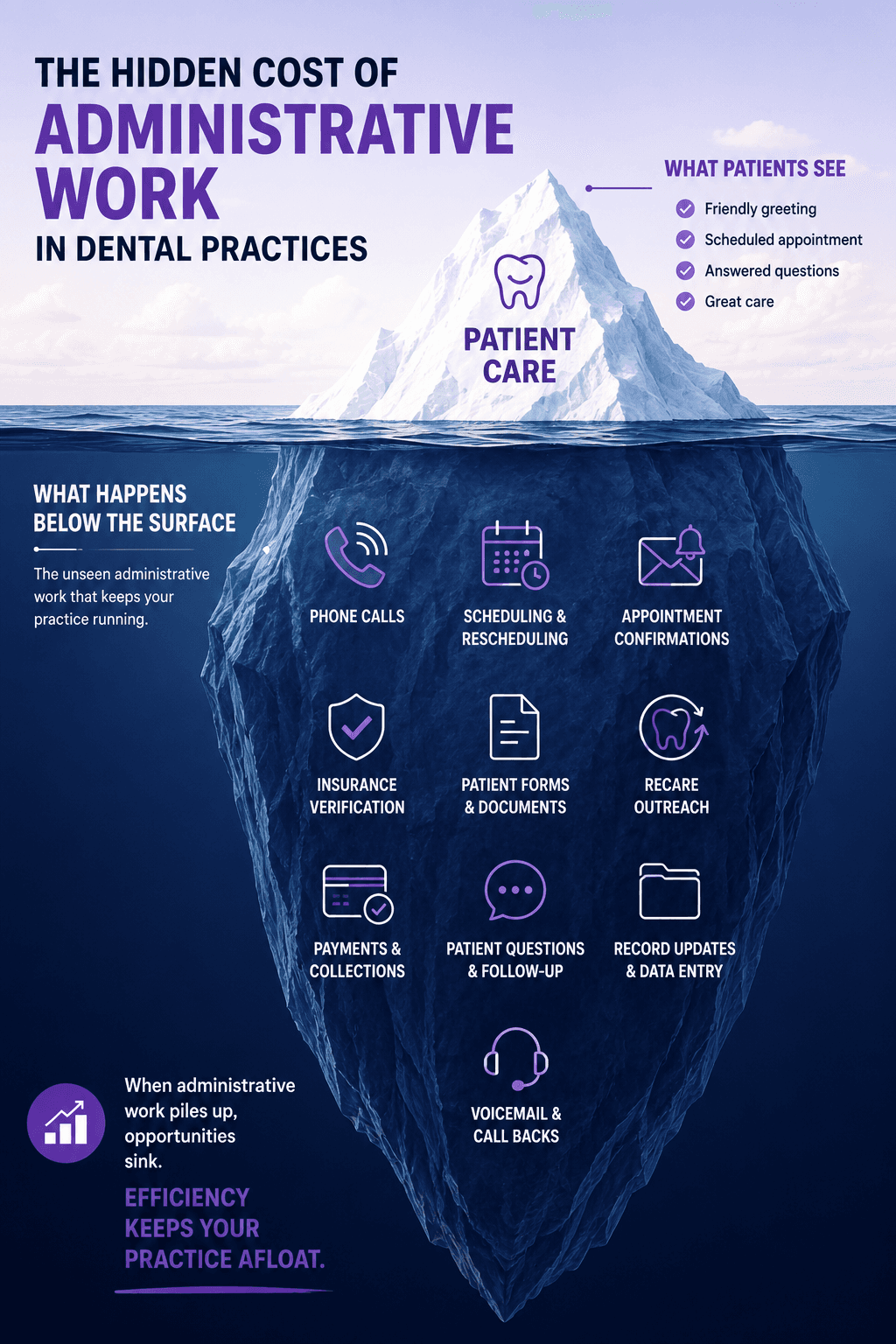
Above the surface, patients may notice:
A friendly greeting
A scheduled appointment
A completed check-in
An answered question
Below the surface, the team is managing:
Phone calls
Voicemails
Insurance verification
Schedule changes
Appointment reminders
Recall lists
Patient forms
Payment questions
Internal messages
Follow-up tasks
This is the administrative iceberg. The visible patient interaction may last only a few minutes, but it is supported by hours of invisible work. As that invisible workload grows, it becomes harder for the team to remain present during the moments patients actually experience.
How Administrative Work Affects Patients
Patients may never see your administrative workload, but they feel its effects.
Longer Hold Times
When the front desk is occupied with manual tasks, callers are more likely to be placed on hold or sent to voicemail.
Slower Responses
Questions about scheduling, insurance, or appointments may require callbacks rather than immediate answers.
Less Personal Attention
A team member attempting to complete several tasks simultaneously may have less time to slow down, listen, and make a patient feel genuinely cared for.
Inconsistent Communication
When communication depends entirely on staff capacity, the patient experience can vary based on the time of day, call volume, or who happens to be available.
More Friction
Every delay, transfer, repeated question, and callback makes interacting with the practice feel slightly more difficult.
Patients may not describe the problem as excessive administration. They simply experience an office that feels rushed, difficult to reach, or less organized than expected.
How Administrative Work Affects the Team
Administrative overload is not a reflection of poor performance. In many cases, it is the result of capable people being asked to manage an unrealistic volume of work.
Over time, that workload can contribute to:
Frequent multitasking
Mental fatigue
Avoidable mistakes
Unfinished tasks
Reduced job satisfaction
Front desk burnout
Staff turnover
Hiring and training a new team member requires additional time, money, and attention. When an overwhelmed employee leaves, the remaining staff inherit even more work while the practice searches for a replacement.
The cost of administrative overload can therefore become cyclical. Too much work creates burnout. Burnout creates turnover. Turnover creates more work.
How Administrative Work Limits Practice Growth
Practices often think about growth in terms of attracting more patients. But growth also depends on whether the practice has the capacity to serve those patients effectively.
If increasing patient volume results in more missed calls, longer response times, and a more overwhelmed team, marketing may amplify the underlying operational problem.
More inquiries enter the practice, but the administrative system struggles to convert and support them.
This creates a difficult situation: the practice appears busy, but opportunities continue to leak through the process.
Sustainable growth requires more than generating demand. It requires the operational capacity to respond to that demand without sacrificing the patient or employee experience.
Which Administrative Tasks Should Be Automated?
Not every administrative task should be handled by technology. Some conversations require judgment, empathy, context, and human connection. However, repetitive and predictable tasks are often strong candidates for automation.
These may include:
Appointment confirmations
Routine scheduling requests
Common patient questions
Hygiene recare outreach
Basic information gathering
Insurance verification workflows
After-hours call handling
Standard follow-up communication
A useful question is:
Does this task require the unique abilities of a trained team member, or does it simply require the same process to be completed consistently?
When the answer is consistency, technology may be able to support the team.
Automation Should Give People Better Work
The purpose of dental office automation should not be to remove people from the patient experience. It should be to remove repetitive work from their day.
A front desk professional creates greater value when helping a nervous patient, resolving a complex scheduling issue, explaining next steps, or building a relationship with a family.
Those interactions require patience, awareness, and empathy. Repeatedly answering the same routine question does not always require those same abilities.
The best automation strategies move routine tasks to technology so people can spend more time on work that depends on being human.
How Annie Reduces Administrative Work
Annie helps dental practices manage repetitive patient communication and administrative workflows without placing another responsibility on the front desk.
Depending on the needs of the practice, Annie can help answer calls, schedule patients, support appointment confirmations, manage recare communication, assist with insurance verification, and respond to common patient needs.
The goal is not to replace the people who make the practice special. It is to give them back time. When routine work is completed consistently, the team experiences fewer interruptions. Patients receive faster responses. Administrative tasks are less likely to accumulate throughout the day.
Instead of asking the front desk to continuously choose between the caller, the patient in front of them, and the next task on the list, Annie helps the practice support all three.
How to Evaluate the Administrative Burden in Your Practice
Administrative overload can become so normal that it is difficult to recognize.
Start by examining where your team's time goes.
Ask:
Which tasks are repeated most often?
Which responsibilities cause the most interruptions?
How many calls reach voicemail?
How much time is spent confirming appointments?
How many hours go toward insurance verification?
Which tasks regularly remain unfinished?
What patient questions are answered repeatedly?
Where does communication slow down?
What work prevents the team from focusing on patients?
You may also ask your front desk team which three responsibilities they would remove from their day if they could. Their answers will often reveal the best places to begin.
The Goal Is Not Zero Administration
Administrative work will always be part of running a dental practice. The goal is not to eliminate it completely.
The goal is to prevent routine administration from consuming the people, time, and attention that make exceptional patient care possible.
A strong administrative system should support the team quietly in the background. It should make the practice easier to reach, easier to navigate, and easier to operate.
When the system works well, patients experience responsiveness and consistency. The team experiences clarity and control. The practice gains room to grow.
Our Final Thoughts
The true cost of administrative work is not measured only in hours or salaries.
It is measured in interrupted conversations, delayed responses, missed opportunities, overwhelmed employees, and time taken away from patients.
Every dental practice needs administration but not every administrative task needs to depend on an already busy person.
By improving workflows and thoughtfully automating repetitive work, practices can give their teams more capacity to solve problems, build relationships, and care for the people in front of them.
That is the real promise of automation. Not a practice without people. A practice where people finally have more time to do the work that matters most.
