Dental Office Efficiency: 12 Proven Ways to Improve Productivity Without Adding Staff

Dental Office Efficiency: 12 Proven Ways to Improve Productivity Without Adding Staff
Running an efficient dental practice has never been more challenging.
Phones ring constantly.
Schedules change by the minute.
Insurance questions pile up.
Patients expect immediate answers.
Meanwhile, your front desk is trying to keep everything moving without letting anything fall through the cracks.
For many practices, the instinctive solution is to hire another employee. Sometimes that's necessary. But more often, the biggest opportunity isn't adding more people. It's improving how the practice operates.
Dental office efficiency isn't about asking your team to work faster. It's about removing friction so they can focus on the work that matters most.
In this guide, we'll explore practical ways to improve efficiency throughout your dental practice while creating a better experience for both patients and staff.
What Is Dental Office Efficiency?
Dental office efficiency is the ability to deliver exceptional patient care while minimizing unnecessary work, delays, and administrative friction.
Efficient practices don't necessarily have fewer responsibilities. They simply complete those responsibilities with fewer interruptions, better systems, and more consistent communication.
Improving efficiency benefits everyone involved.
Patients enjoy a smoother experience.
Staff experience less stress.
Providers spend more time practicing dentistry.
The practice becomes more profitable without sacrificing quality.
Why Efficiency Matters More Than Ever
Today's dental offices face increasing demands.
Patients expect immediate communication.
Insurance requirements continue growing.
Labor shortages make hiring more difficult.
Administrative work consumes more time than ever before.
At the same time, patients compare your practice to experiences outside of healthcare.
They expect the convenience of Amazon.
The responsiveness of Uber.
The simplicity of online banking.
Meeting those expectations requires modern systems, not simply working harder.
The Workflow Wheel
Many practices think workflow is a checklist. Complete one task and move to the next. Reality looks very different. Front desk work is circular. Everything connects. Imagine your front desk as a continuously turning wheel.
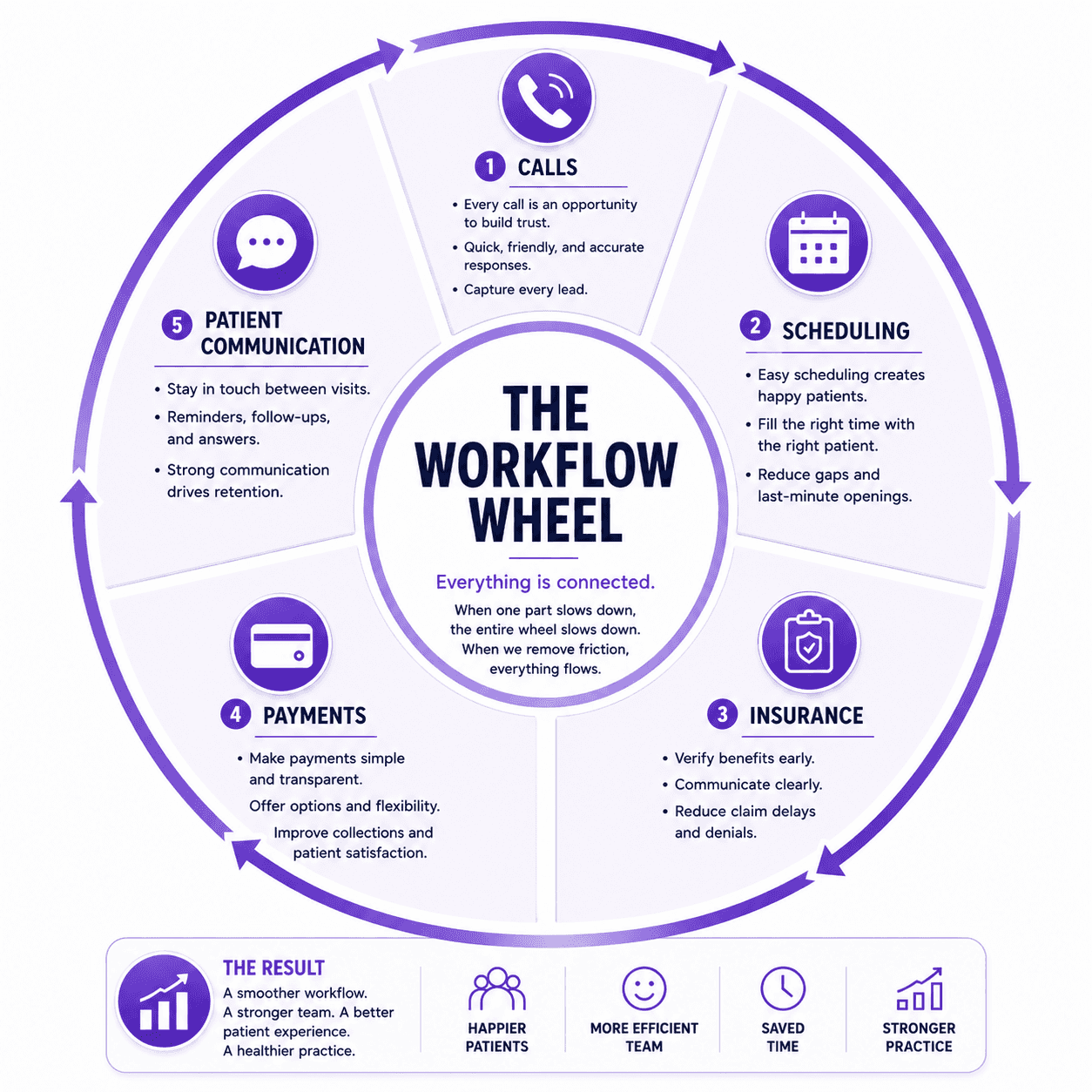
Every section depends on the others. When one slows down, the entire wheel loses momentum.
When repetitive work is removed, everything begins moving more smoothly. Efficiency isn't about speeding up one task. It's about keeping the entire wheel turning.
12 Ways to Improve Dental Office Efficiency
1. Reduce Phone Interruptions
Every incoming call interrupts another task. Answering every call is important.
Constant interruptions aren't. Creating systems that reduce repetitive phone conversations allows staff to stay focused.
2. Standardize Common Processes
Scheduling.
Check-in.
Insurance verification.
Treatment coordination.
The more consistent your workflows become, the fewer decisions staff must make throughout the day. Consistency creates speed.
3. Schedule the Next Appointment Before Patients Leave
This simple habit reduces future administrative work while improving patient retention.
4. Eliminate Duplicate Work
How many times is the same information entered? Repeated? Confirmed?
Reducing duplicate tasks creates immediate efficiency gains.
5. Centralize Patient Communication
Patients communicate through:
Calls
Texts
Emails
Website forms
Voicemail
Managing these channels consistently prevents information from being lost.
6. Minimize Context Switching
One of the biggest hidden productivity killers is constant task switching.
Answering phones while checking patients in, verifying insurance, and collecting payments forces employees to repeatedly change focus.
Reducing context switching improves both speed and accuracy.
7. Use Automation for Repetitive Tasks
Not every conversation requires a staff member.
Routine communication like appointment confirmations, recare reminders, scheduling assistance, and answering common questions can often be handled automatically.
This allows your team to focus on conversations that truly require a human touch.
8. Review Bottlenecks Regularly
Ask your team: "What slows you down every day?"
The answers are often surprisingly consistent. Those recurring frustrations become your biggest opportunities for improvement.
9. Measure Response Time
One of the easiest operational improvements is simply responding faster. Quick responses improve patient satisfaction while reducing follow-up work later.
If you haven't already, our guide on Why Every Dental Practice Should Measure Response Time explores this concept in greater detail.
10. Build Systems Instead of Relying on Memory
Efficient practices don't depend on remembering every task. They depend on repeatable systems.
Checklists.
Templates.
Automation.
Clear responsibilities.
Systems create consistency.
11. Invest in Team Training
The best technology still requires confident people. Regular training ensures everyone understands your systems and follows the same processes.
12. Improve the Entire Patient Journey
Efficiency isn't only internal. Patients also experience workflow.
Simple scheduling.
Clear communication.
Short wait times.
Easy follow-up.
Operational improvements become patient experience improvements.
How AI Is Improving Dental Office Efficiency
Artificial intelligence is quickly becoming one of the most valuable operational tools available to dental practices.
Rather than replacing employees, AI handles repetitive administrative work that often prevents staff from focusing on patients.
Examples include:
Answering phone calls
Scheduling appointments
Appointment confirmations
Recare outreach
Insurance questions
Frequently asked questions
After-hours communication
When routine conversations are handled immediately, front desk teams gain more uninterrupted time to support patients inside the office.
Where Annie Fits
Efficiency isn't about doing more work. It's about removing the work that doesn't require your team's attention.
Annie answers every call, helps patients schedule appointments, responds to common questions, and supports communication around the clock.
By reducing repetitive administrative tasks, Annie helps keep the Workflow Wheel turning. This allows your staff to spend more time building relationships instead of managing interruptions.
Signs Your Practice Could Be More Efficient
If any of these sound familiar, your practice likely has opportunities to improve efficiency:
Calls regularly go unanswered.
Staff constantly switch between tasks.
Insurance verification delays appointments.
Patients wait for callbacks.
Schedules change throughout the day.
Administrative work spills into lunch breaks or after hours.
Team members feel busy all day but struggle to finish everything.
Efficiency problems rarely stem from one major issue. They're usually the result of dozens of small inefficiencies adding up over time.
Our Final Thoughts
Every dental practice wants to provide exceptional patient care. The challenge isn't knowing what great care looks like. It's creating systems that allow your team to consistently deliver it.
Improving dental office efficiency doesn't require a complete operational overhaul. It starts by identifying unnecessary friction, simplifying communication, and removing repetitive work wherever possible.
The practices that invest in efficiency today will be better equipped to meet the expectations of tomorrow's patients, all while creating a healthier work environment for their teams.
