Why Dental Practices Lose New Patients Before They Ever Book an Appointment

Why Dental Practices Lose New Patients Before They Ever Book an Appointment
Every dental practice wants more new patients. That's why practices invest in SEO, Google Ads, social media, referrals, direct mail, and community events.
The goal is simple: get the phone to ring. But here's the uncomfortable truth. Most dental practices don't have a marketing problem. They have a conversion problem.
The moment a prospective patient decides to contact your office, months of marketing effort come down to a single interaction.
Does someone answer the phone?
Can the patient get the information they need?
Is scheduling easy?
Or does that opportunity quietly disappear?
For many practices, the biggest source of lost growth isn't a lack of leads—it's what happens after those leads arrive.
The Most Valuable New Patient Is the One You've Already Paid to Attract
Think about everything that happens before someone calls your office.
They search Google.
They compare reviews.
They visit your website.
They ask friends for recommendations.
Maybe they click on one of your ads.
By the time they decide to contact your practice, you've already invested time, money, and effort into earning their attention. That phone call isn't the beginning of the patient journey. It's the moment your marketing finally pays off.
Every missed opportunity after that point makes every marketing dollar less effective.
The New Patient Conversion Funnel
Most practices think about patient acquisition like this:
Marketing → Appointment → Patient
In reality, there are far more steps, and every step is an opportunity to gain or lose trust.
The New Patient Conversion Funnel
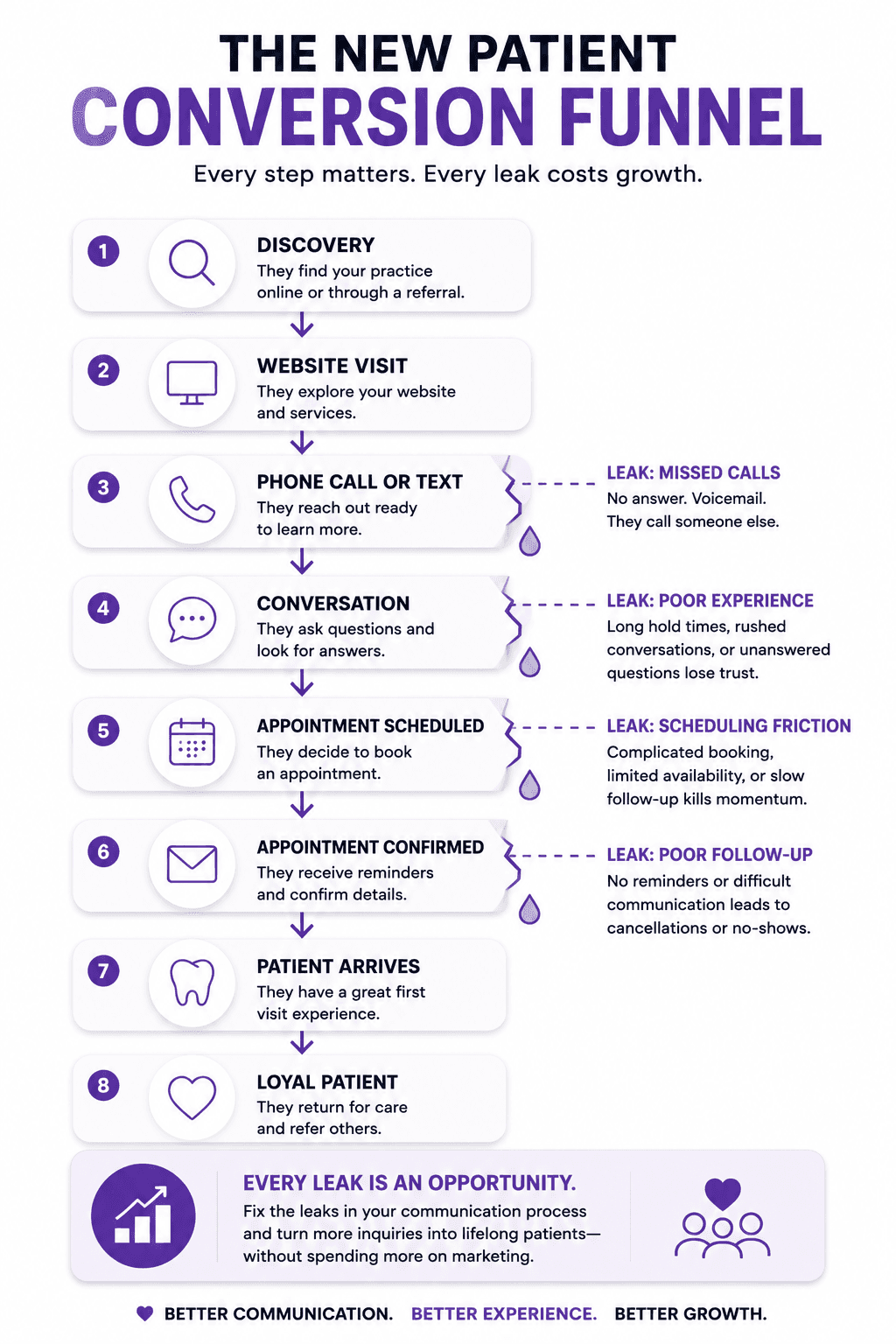
The further someone moves through this journey, the more valuable they become. But many practices unknowingly lose patients long before the appointment is ever booked.
Where Practices Lose New Patients
Missed Phone Calls
Imagine spending hundreds, or even thousands, of dollars generating new patient inquiries.
Then someone calls...and reaches voicemail.
Some patients leave a message, but the majority don't. Instead, they call another dental practice. Every unanswered call represents more than a missed conversation.
It represents marketing dollars that never turned into a patient.
Long Hold Times
Patients are busy. If they're placed on hold for several minutes, many assume the office is overwhelmed or unavailable. Whether that's true doesn't matter. First impressions happen quickly and today's patients have plenty of alternatives.
Complicated Scheduling
Patients want healthcare to feel as convenient as the rest of their lives. If scheduling requires multiple phone calls, callbacks, or unnecessary friction, enthusiasm begins to fade. The easier it is to schedule, the more likely patients are to follow through.
Slow Responses
Communication speed has become part of the patient experience. A delayed response doesn't just slow down scheduling. It creates uncertainty.
Patients start wondering:
"Did they get my message?"
"Should I call again?"
"Maybe I'll try somewhere else."
The Hidden Cost of Lost Opportunities
Most practices notice missed appointments. Few notice missed opportunities. That's because the patient who never books doesn't appear anywhere on tomorrow's schedule. They're invisible, but their value is very real.
Consider one new patient who would have:
Completed regular hygiene visits.
Accepted restorative treatment.
Returned for years.
Referred family and friends.
Losing that patient isn't just losing one appointment. It's losing years of future relationships.
Great Marketing Deserves Great Communication
Marketing and patient communication shouldn't be viewed as separate parts of your business. They're part of the same system.
The best marketing campaign in the world can't overcome poor communication after a patient reaches out. Likewise, excellent communication amplifies every marketing investment you make.
When patients receive fast, professional responses, they're more likely to:
Schedule appointments.
Show up.
Leave positive reviews.
Return for future care.
Refer others.
Communication is what turns attention into trust.
Why Front Desk Teams Feel Overwhelmed
If communication is so important, why do opportunities still get missed? Usually, it has nothing to do with effort.
Today's front desk teams are expected to:
Answer every phone call.
Check patients in.
Schedule appointments.
Verify insurance.
Collect payments.
Help providers.
Respond to texts.
Manage emergencies.
Even exceptional teams eventually reach capacity. When everything feels urgent, something inevitably waits. Often, it's the next new patient.
Protecting the Leads You've Already Earned
The easiest way to grow isn't always generating more leads. Sometimes it's converting more of the ones you already have.
Leading dental practices focus on reducing friction throughout the patient journey by:
Answering more calls.
Reducing hold times.
Making scheduling easier.
Responding faster.
Following up consistently.
Creating clear communication at every touchpoint.
Small improvements across each stage often produce significant gains in patient acquisition.
How Annie Helps Practices Convert More New Patients
Annie was built around a simple idea: Every patient deserves an immediate, helpful response.
By answering calls, assisting with scheduling, responding to common patient questions, and supporting patients after hours, Annie helps practices capture more of the opportunities they've already worked hard to create.
Rather than replacing your front desk, Annie extends it.
Routine conversations happen without delay.
Your team gains more time to focus on patients in the office.
New patients receive the responsive experience they expect from their very first interaction.
That's better for your patients, better for your team, and better for every marketing dollar your practice invests.
A Simple Question Every Practice Should Ask
Before increasing your marketing budget, ask yourself:
How many calls reach voicemail every week?
How many prospective patients hang up before speaking with someone?
How quickly are new patient inquiries answered?
How easy is it to schedule an appointment?
What percentage of interested patients actually become scheduled patients?
The answers often reveal that the biggest opportunity isn't generating more interest. It's converting more of the interest you already have.
Our Final Thoughts
Growing a dental practice isn't just about attracting more patients. It's about making sure the patients you've already attracted have an easy path to becoming part of your practice.
Every phone call answered.
Every question resolved.
Every appointment scheduled.
Every first impression improved.
Those small moments don't only improve communication, they improve growth. The most valuable new patient isn't the one you're still trying to find. It's the one who's already decided to call.
