How to Improve the Dental Patient Experience: A Complete Guide for Modern Practices

How to Improve the Dental Patient Experience: A Complete Guide for Modern Practices
When most dental practices think about the patient experience, they think about what happens once someone walks through the front door.
Was the office clean?
Was the dentist friendly?
Did treatment go well?
Those moments absolutely matter. But they aren't where the patient experience begins anymore. Today's patients start forming opinions about your practice long before they ever sit in the chair.
It begins with a Google search.
It continues through your website.
It grows (or disappears) during the first phone call.
It changes while they're waiting for a callback.
It evolves when they receive appointment reminders.
By the time a patient walks through your front door, they've already experienced dozens of small moments that shape how they feel about your practice.
The modern dental patient experience isn't a single interaction. It's a series of connected interactions.
Practices that understand this create happier patients, stronger online reviews, higher treatment acceptance, and better long-term retention.
Practices that don't often wonder why marketing isn't producing better results—even when clinical care is excellent.
What Is the Dental Patient Experience?
The dental patient experience includes every interaction a patient has with your practice before, during, and after treatment.
That includes:
Finding your practice online
Reading reviews
Visiting your website
Calling the office
Scheduling an appointment
Receiving reminders
Checking in
Meeting the clinical team
Receiving treatment
Following up afterward
Each interaction contributes to one overall impression. Patients rarely separate these experiences. To them, it's all part of the same journey.
The Front Desk Shapes More of the Patient Experience Than Most Practices Realize
Dentists understandably focus on clinical excellence. That's what patients ultimately come for. But patients spend surprisingly little time evaluating your dentistry before deciding whether they trust your practice.
Instead, they evaluate your communication.
Can they reach someone?
Do they get answers quickly?
Is scheduling easy?
Are reminders clear?
Does someone follow up?
These moments often determine whether a prospective patient books an appointment or looks elsewhere.
For many practices, the front desk becomes the single biggest influence on the patient experience. Not because the team isn't working hard, but because they're handling hundreds of competing priorities every day.
Phone calls
Insurance questions
Patient check-in
Treatment coordination
Scheduling
Rescheduling
Voicemails
Walk-ins
Paperwork
The result isn't poor customer service. It's simply too much work happening at once.
Introducing the Annie Framework:
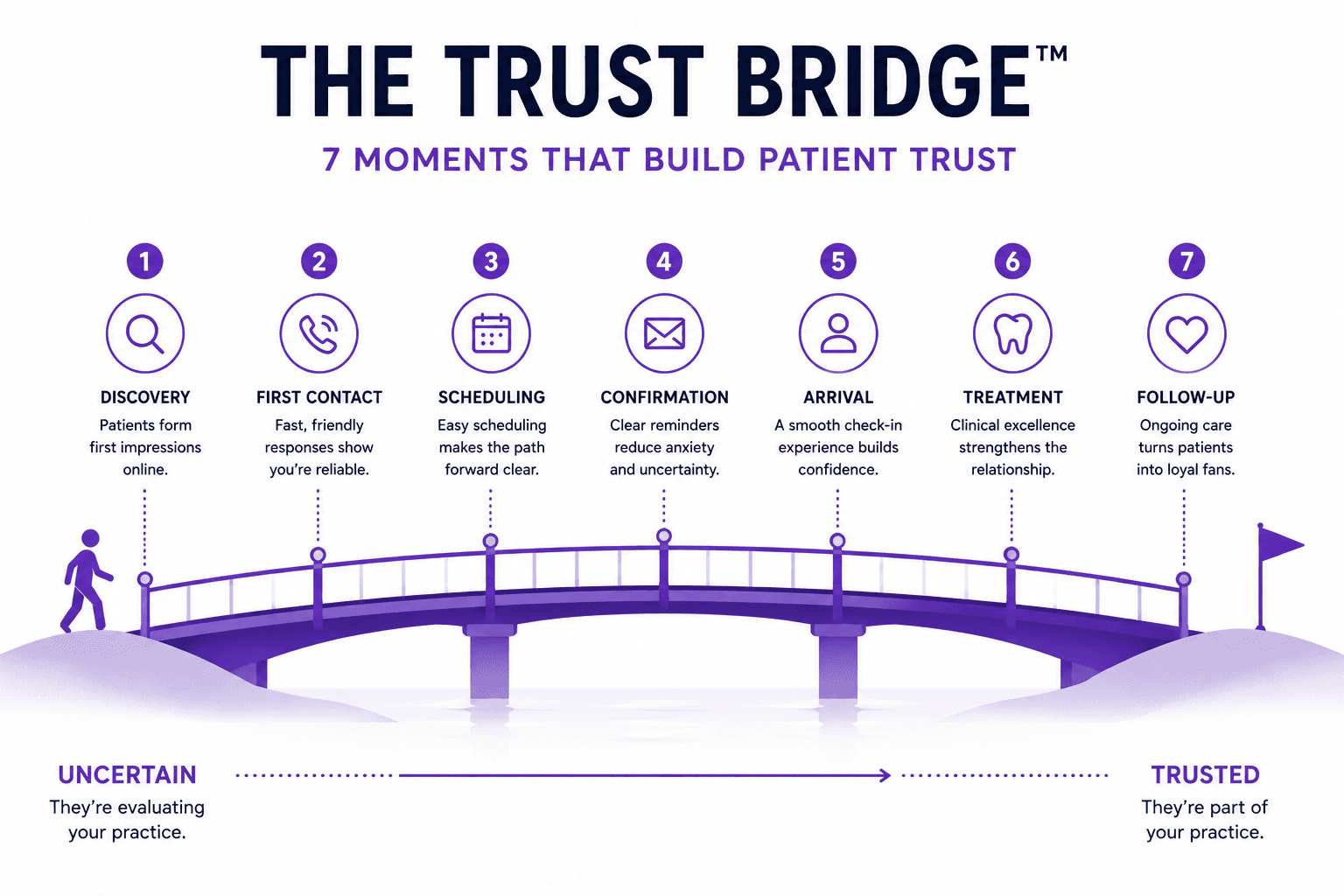
One of the biggest misconceptions in dentistry is that trust begins during treatment. In reality, trust starts much earlier. Imagine trust as a bridge connecting a prospective patient to your practice.
Every interaction either helps the patient cross that bridge, or makes them hesitate.
The small moments matter, like:
One missed call
One confusing reminder
One delayed response
None of these events seem catastrophic on their own. But together, they create uncertainty.
Conversely, every positive interaction moves patients closer to confidence.The practices with the strongest patient experience aren't necessarily those with the newest technology or fanciest office. They're the ones that consistently make crossing the bridge feel easy.
The Seven Moments That Build Patient Trust
1. Discovery
Patients often discover your practice through Google Search, Google Maps, referrals, or social media. Questions immediately begin forming.
Can I trust them?
Are they professional?
Will they answer the phone?
Do they seem modern?
Your online presence creates the first impression before anyone speaks to your team.
2. First Contact
Whether someone calls, submits a form, or sends a text message, this interaction carries enormous weight.
Fast responses communicate professionalism.
Delayed responses communicate uncertainty.
Patients frequently assume slow communication reflects how the practice operates overall.
3. Scheduling
Scheduling shouldn't feel like solving a puzzle. Patients appreciate simple, frictionless appointment booking. The easier scheduling feels, the more confidence patients develop.
4. Confirmation
Appointment confirmations reduce anxiety. Patients know exactly where they're going, what time they'll arrive, and what they'll need. Simple communication reduces uncertainty.
5. Arrival
The office experience should match expectations established earlier. Patients appreciate consistency. When digital communication and in-office service align, trust grows naturally.
6. Treatment
This is where clinical excellence shines. But by now, much of the trust has already been established. Excellent treatment strengthens the relationship that communication began building.
7. Follow-Up
Many practices unintentionally end the patient experience after treatment.
The strongest practices continue communicating, checking in, sending recare reminders, making future scheduling simple, and following up transforms satisfied patients into loyal patients.
Common Patient Experience Mistakes
Many patient experience problems aren't dramatic. They're small points of friction that repeat throughout the day.
Examples include:
Long hold times
Missed phone calls
Delayed callbacks
Difficult scheduling
Unclear appointment reminders
Missed follow-up communication
Patients repeating information multiple times
Individually, these seem minor. Collectively, they shape how patients remember your practice.
How Technology Can Improve the Dental Patient Experience
Improving patient experience doesn't necessarily require hiring more staff. Sometimes it means giving your existing team more room to focus on patients standing in front of them.
Modern dental practices increasingly automate repetitive communication tasks like:
Answering calls
Appointment scheduling
Appointment confirmations
Recare outreach
Insurance verification
Frequently asked questions
Automation doesn't replace human relationships. It removes repetitive work so staff can spend more time creating meaningful ones.
Where Annie Fits
At Annie, we believe every patient deserves a fast, friendly, and consistent experience from the very first interaction.
That's why Annie answers every call, helps patients schedule appointments, manages routine communication, and supports your front desk around the clock.
Rather than replacing your team, Annie helps eliminate the communication bottlenecks that often stand between patients and great care. The result is a smoother experience for patients and more breathing room for your staff.
Great Patient Experiences Compound
Patient experience isn't simply about making patients happier. It creates measurable business outcomes.
Practices with strong patient experiences often see:
Higher patient retention
Better online reviews
More referrals
Increased treatment acceptance
Fewer missed appointments
Stronger marketing ROI
Higher staff satisfaction
Each improvement reinforces the next and better communication leads to better trust. Better trust leads to better relationships and better relationships lead to sustainable growth.
Our Final Thoughts
The best dental practices don't leave the patient experience to chance. They design it with:
Every phone call
Every reminder
Every interaction
Every follow-up
Patients remember how easy or difficult it felt to become part of your practice. When communication is thoughtful, responsive, and consistent, trust grows naturally. When trust grows, everything else becomes easier.
